Ch. 5 - Alkenes: Structure, Nomenclature, and an Introduction to Reactivity • Thermodynamics and Kinetics
Bruice - Organic Chemistry 8th Edition
Bruice8th EditionOrganic ChemistryISBN: 9780135213711Not the one you use?Change textbook
Chapter 6, Problem 28

Rank the following compounds from most stable to least stable:
trans-3-hexene, cis-3-hexene, cis-2,5-dimethyl-3-hexene, (Z)-3,4-dimethyl-3-hexene

Verified step by step guidance
1
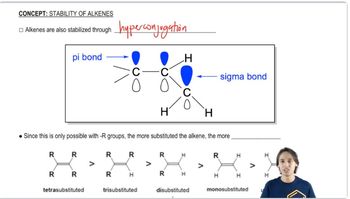
Step 1: Understand the stability of alkenes. Alkene stability is influenced by factors such as steric hindrance, hyperconjugation, and the degree of substitution of the double bond. More substituted alkenes are generally more stable due to hyperconjugation and electron-donating effects of alkyl groups.
Step 2: Analyze the degree of substitution for each compound. Count the number of alkyl groups attached to the double-bonded carbons. For example, trans-3-hexene and cis-3-hexene are disubstituted alkenes, while cis-2,5-dimethyl-3-hexene and (Z)-3,4-dimethyl-3-hexene are tetrasubstituted alkenes.
Step 3: Consider the stereochemistry of the alkenes. Trans alkenes (E configuration) are generally more stable than cis alkenes (Z configuration) due to reduced steric hindrance between substituents on opposite sides of the double bond.
Step 4: Compare the steric hindrance in the tetrasubstituted alkenes. In cis-2,5-dimethyl-3-hexene, the substituents on the same side of the double bond create more steric strain compared to (Z)-3,4-dimethyl-3-hexene, where the substituents are positioned differently.
Step 5: Rank the compounds based on the above factors. The order of stability will depend on the degree of substitution and the stereochemistry, with tetrasubstituted alkenes being more stable than disubstituted ones, and trans configurations being more stable than cis configurations.

Verified video answer for a similar problem:

This video solution was recommended by our tutors as helpful for the problem above.
Video duration:
9m
Was this helpful?

Key Concepts

Here are the essential concepts you must grasp in order to answer the question correctly.

Stability of Alkenes

The stability of alkenes is influenced by factors such as steric strain and hyperconjugation. Generally, more substituted alkenes are more stable due to increased hyperconjugation and reduced steric hindrance. For example, tetrasubstituted alkenes are typically more stable than disubstituted ones.
Recommended video:
Guided course
04:28
Understanding trends of alkene stability.

Geometric Isomerism

Geometric isomerism, or cis-trans isomerism, occurs due to restricted rotation around a double bond. In alkenes, the 'cis' configuration has substituents on the same side, while 'trans' has them on opposite sides. The trans isomers are usually more stable than their cis counterparts due to reduced steric interactions.
Recommended video:
Guided course
06:47
Monosaccharides - D and L Isomerism

Substituent Effects on Alkene Stability

The presence and position of substituents on an alkene can significantly affect its stability. Bulky groups can create steric strain when positioned close together, while electron-donating groups can stabilize the double bond through hyperconjugation. Understanding these effects is crucial for ranking the stability of different alkene isomers.
Recommended video:
Guided course
04:28
Understanding trends of alkene stability.