
The same alkane is obtained from the catalytic hydrogenation of both alkene A and alkene B. The heat of hydrogenation of alkene A is 29.8 kcal/mol, and the heat of hydrogenation of alkene B is 31.4 kcal/mol. Which alkene is more stable?
Ch. 5 - Alkenes: Structure, Nomenclature, and an Introduction to Reactivity • Thermodynamics and Kinetics
All textbooks
Bruice 8th Edition
Ch. 5 - Alkenes: Structure, Nomenclature, and an Introduction to Reactivity • Thermodynamics and Kinetics
Problem 24b
Bruice 8th Edition
Ch. 5 - Alkenes: Structure, Nomenclature, and an Introduction to Reactivity • Thermodynamics and Kinetics
Problem 24bChapter 6, Problem 24b
What alkene would you start with if you wanted to synthesize
b. ethylcyclopentane?
Verified step by step guidance1
Identify the target molecule, ethylcyclopentane, which consists of a cyclopentane ring with an ethyl group (-CH2CH3) attached to it.
Determine the reaction type that can be used to synthesize ethylcyclopentane. A common method is the hydrogenation of an alkene, where an alkene reacts with H2 in the presence of a catalyst to form an alkane.
Work backward to identify the alkene precursor. Remove the ethyl group (-CH2CH3) from the cyclopentane structure to determine the corresponding alkene. This suggests the starting alkene should have a double bond where the ethyl group will be added.
Propose the structure of the starting alkene. The most likely candidate is cyclopentene, with a double bond in the cyclopentane ring, and ethylene (CH2=CH2) as the source of the ethyl group.
Consider the reaction mechanism. The synthesis can be achieved through an alkene addition reaction, such as hydroalkylation, where ethylene reacts with cyclopentene in the presence of a catalyst to form ethylcyclopentane.

Verified video answer for a similar problem:
This video solution was recommended by our tutors as helpful for the problem above.
Video duration:
3mWas this helpful?
Key Concepts
Here are the essential concepts you must grasp in order to answer the question correctly.
Alkene Reactivity
Alkenes are hydrocarbons that contain at least one carbon-carbon double bond, making them reactive intermediates in organic synthesis. Their reactivity allows them to undergo various reactions, such as addition reactions, which can be utilized to form more complex structures. Understanding the reactivity of alkenes is crucial for determining which alkene can be transformed into the desired product.
Recommended video:
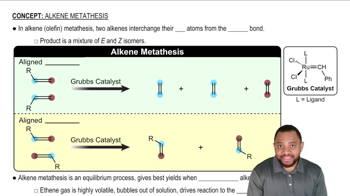
Alkene Metathesis Concept 1
Cyclization Reactions
Cyclization reactions involve the formation of cyclic compounds from acyclic precursors. In the case of synthesizing ethylcyclopentane, a key step would be the cyclization of a suitable alkene to form a five-membered ring. Recognizing the conditions and mechanisms that favor cyclization is essential for successfully constructing cyclic structures in organic synthesis.
Recommended video:
Guided course
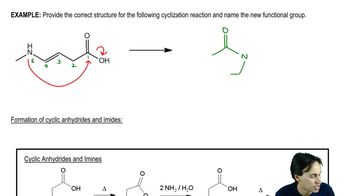
Cyclization Reaction
Synthetic Pathways
Synthetic pathways refer to the series of chemical reactions and transformations used to convert starting materials into a target compound. Identifying the correct synthetic pathway involves understanding the functional groups present, the types of reactions that can be performed, and the order of steps needed to achieve the desired product. This knowledge is vital for planning the synthesis of ethylcyclopentane from an appropriate alkene.
Recommended video:
Energy Production In Biochemical Pathways Concept 1
Related Practice
Textbook Question
1
views
Textbook Question
a. For a reaction with ∆H° = -12 kcal/mol and ∆S° = 0.01 kcal mol-1 K-1, calculate the ∆G° and the equilibrium constant at:
1. 30 °C and 2. 150 °C.
b. How does ∆G° change as T increases?
c. How does Keq change as T increases?
2
views
Textbook Question
What alkene would you start with if you wanted to synthesize
a. pentane?
2
views
Textbook Question
Rank the following compounds from most stable to least stable:
trans-3-hexene, cis-3-hexene, cis-2,5-dimethyl-3-hexene, (Z)-3,4-dimethyl-3-hexene
1
views
Textbook Question
a. For which reaction in each set will ∆S° be more significant?
b. For which reaction will ∆S° be positive?
1. A ⇌ B or A + B ⇌ C
2. A ⇌ B + C or A + B ⇌ C + D
Textbook Question
How many different alkenes can be hydrogenated to form
a. butane?
b. 3-methylpentane?
1
views