Ch. 16 - Reactions of Aldehydes and Ketones • More Reactions of Carboxylic Acid Derivatives
Bruice - Organic Chemistry 8th Edition
Bruice8th EditionOrganic ChemistryISBN: 9780135213711Not the one you use?Change textbook
Chapter 17, Problem 5

What products are formed when the following compounds react with CH3MgBr, followed by the addition of dilute acid? Disregard stereoisomers.
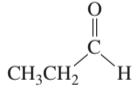
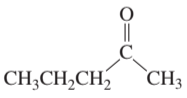
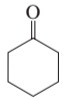
a. b. c. Chemical structure of a ketone featuring a carbonyl group attached to a hexagonal ring.

Verified step by step guidance
1
Identify the type of compound in each case. Both compounds (a and b) contain a carbonyl group (C=O), which is highly reactive with Grignard reagents like CH3MgBr. Grignard reagents act as nucleophiles, attacking the electrophilic carbon of the carbonyl group.
For compound (a), CH3CH2(C=O)H (an aldehyde): The CH3MgBr will attack the carbonyl carbon, breaking the π-bond of the C=O group. This forms an alkoxide intermediate. The addition of dilute acid (H3O+) will protonate the alkoxide, resulting in a secondary alcohol.
For compound (b), CH3CH2CH2(C=O)CH3 (a ketone): The CH3MgBr will similarly attack the carbonyl carbon, breaking the π-bond of the C=O group. This forms an alkoxide intermediate. The addition of dilute acid (H3O+) will protonate the alkoxide, resulting in a tertiary alcohol.
Write the general reaction for Grignard reagents with aldehydes and ketones: Aldehyde + R-MgBr → Secondary alcohol (after acid workup); Ketone + R-MgBr → Tertiary alcohol (after acid workup).
Determine the specific products: For (a), the product is CH3CH2CH(OH)CH3 (a secondary alcohol). For (b), the product is CH3CH2CH2C(OH)(CH3)CH3 (a tertiary alcohol).

Verified video answer for a similar problem:

This video solution was recommended by our tutors as helpful for the problem above.
Was this helpful?

Key Concepts

Here are the essential concepts you must grasp in order to answer the question correctly.

Grignard Reagents

Grignard reagents, such as CH3MgBr, are organomagnesium compounds that act as nucleophiles. They readily react with electrophiles, particularly carbonyl compounds, to form alcohols. The carbon atom in the Grignard reagent donates a pair of electrons to the electrophilic carbon in the carbonyl group, leading to the formation of a new carbon-carbon bond.
Recommended video:
Guided course
02:12
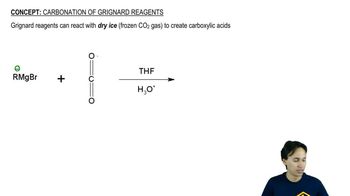
Carbonation of Grignard Reagents

Carbonyl Compounds

Carbonyl compounds, characterized by the C=O functional group, include aldehydes and ketones. In the context of the question, the carbonyl carbon is electrophilic and susceptible to nucleophilic attack by Grignard reagents. The reaction typically results in the formation of an alkoxide intermediate, which can be protonated in a subsequent step to yield an alcohol.
Recommended video:
Guided course
01:40
Defining meso compounds.

Acid Workup

An acid workup is a common procedure following reactions involving Grignard reagents. After the nucleophilic addition, the reaction mixture is treated with dilute acid, which protonates the alkoxide intermediate formed during the reaction. This step is crucial for converting the alkoxide into the corresponding alcohol, completing the transformation of the original carbonyl compound.
Recommended video:
Guided course
01:31
Oxidative Workup Mechanism: