Ch. 16 - Reactions of Aldehydes and Ketones • More Reactions of Carboxylic Acid Derivatives
Bruice - Organic Chemistry 8th Edition
Bruice8th EditionOrganic ChemistryISBN: 9780135213711Not the one you use?Change textbook
Chapter 17, Problem 7a

How many stereoisomers are obtained from the reaction of 2-pentanone with ethylmagnesium bromide followed by the addition of dilute acid?

Verified step by step guidance
1
Identify the reaction type: The reaction involves the addition of ethylmagnesium bromide (a Grignard reagent) to 2-pentanone (a ketone), followed by acidic workup. This is a nucleophilic addition reaction where the Grignard reagent adds to the carbonyl group of the ketone.
Analyze the product structure: The addition of the Grignard reagent to the carbonyl group of 2-pentanone forms a new carbon-carbon bond, resulting in a tertiary alcohol. The carbonyl carbon becomes a stereogenic center (chiral center) because it is bonded to four different groups after the reaction.
Determine the number of stereoisomers: A molecule with one chiral center can have 2n stereoisomers, where n is the number of chiral centers. Since the product has one chiral center, the number of stereoisomers is 21 = 2.
Consider the stereochemistry: The two stereoisomers are enantiomers, which are non-superimposable mirror images of each other. These arise because the Grignard reagent can attack the planar carbonyl group from either the top or bottom face, leading to two possible configurations (R and S) at the chiral center.
Summarize the result: The reaction of 2-pentanone with ethylmagnesium bromide followed by dilute acid produces two stereoisomers, which are enantiomers of each other.

Verified video answer for a similar problem:

This video solution was recommended by our tutors as helpful for the problem above.
Video duration:
3m
Was this helpful?

Key Concepts

Here are the essential concepts you must grasp in order to answer the question correctly.

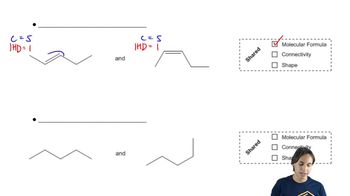
Stereoisomerism

Stereoisomerism refers to the phenomenon where compounds have the same molecular formula and connectivity of atoms but differ in the spatial arrangement of those atoms. This can lead to different physical and chemical properties. In organic chemistry, stereoisomers include enantiomers and diastereomers, which are crucial for understanding the behavior of chiral molecules.
Recommended video:
Guided course
01:58
Determining when molecules are stereoisomers.

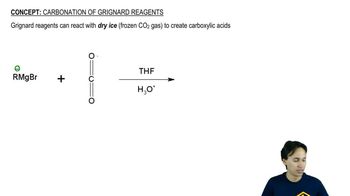
Grignard Reagents

Grignard reagents are organomagnesium compounds that are highly reactive and used in organic synthesis to form carbon-carbon bonds. When 2-pentanone reacts with ethylmagnesium bromide, it undergoes nucleophilic addition, leading to the formation of a tertiary alcohol. The reaction's stereochemistry is influenced by the configuration of the carbon center involved.
Recommended video:
Guided course
02:12
Carbonation of Grignard Reagents

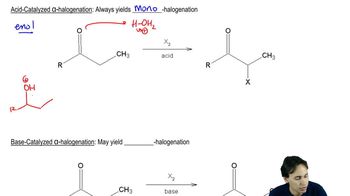
Acid-Catalyzed Hydrolysis

Acid-catalyzed hydrolysis is a reaction where an organic compound reacts with water in the presence of an acid, leading to the formation of alcohols or other functional groups. In the context of the reaction with 2-pentanone, the addition of dilute acid after the Grignard reaction helps to protonate the alkoxide intermediate, resulting in the final alcohol product, which can exhibit stereoisomerism.
Recommended video:
Guided course
03:09
Acid Catalyzed