
Textbook Question
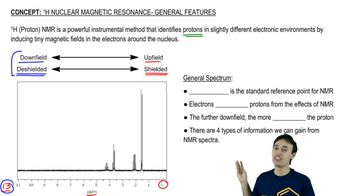
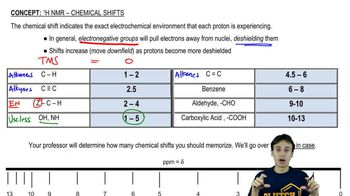
Draw the NMR spectrum expected from ethanol that has been shaken with a drop of D2O.
1
views

 Verified step by step guidance
 10:06
10:06
 11:44
11:44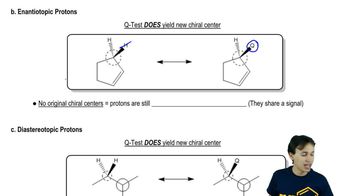 11:40
11:40Draw the NMR spectrum expected from ethanol that has been shaken with a drop of D2O.
Propose chemical structures consistent with the following NMR spectra and molecular formulas. In spectrum (a), explain why the peaks around δ1.65 and δ3.75 are not clean multiplets, but show complex splitting.
(a) <IMAGE>
The spectrum of trans-hex-2-enoic acid follows.
(a) Assign peaks to show which protons give rise to which peaks in the spectrum.
(b) Draw a tree to show the complex splitting of the vinyl proton centered around 7 ppm. Estimate the values of the coupling constants.
If the imaginary replacement of either of two protons forms enantiomers, then those protons are said to be enantiotopic. The NMR is not a chiral probe, and it cannot distinguish between enantiotopic protons. They are seen to be “equivalent by NMR.”
(a) Use the imaginary replacement technique to show that the two allylic protons (those on C3) of allyl bromide are enantiotopic.
Propose mechanisms to show the interchange of protons between ethanol molecules under
(a) acid catalysis.
(b) base catalysis.
Predict the theoretical number of different NMR signals produced by each compound, and give approximate chemical shifts. Point out any diastereotopic relationships.
a. 2-bromobutane
b. cyclopentanol