Draw the NMR spectrum expected from ethanol that has been shaken with a drop of D2O.
Ch. 13 - Nuclear Magnetic Resonance Spectroscopy
Chapter 13, Problem 21a
Propose chemical structures consistent with the following NMR spectra and molecular formulas. In spectrum (a), explain why the peaks around δ1.65 and δ3.75 are not clean multiplets, but show complex splitting.
(a) <IMAGE>
Verified step by step guidance1
Step 1: Analyze the molecular formula C₄H₁₀O₂. This indicates the presence of 4 carbons, 10 hydrogens, and 2 oxygen atoms. The molecule could be an ether or alcohol, as these functional groups commonly contain oxygen atoms.
Step 2: Examine the NMR spectrum. Peaks around δ1.65 and δ3.75 show complex splitting patterns. This suggests that the protons responsible for these signals are experiencing coupling with multiple neighboring protons, leading to intricate splitting.
Step 3: Consider the peak at δ1.65. This region typically corresponds to protons on carbons adjacent to other functional groups, such as alcohols or ethers. The complex splitting indicates coupling with protons on nearby carbons, possibly in a branched structure.
Step 4: Examine the peak at δ3.75. This region is characteristic of protons on carbons directly bonded to oxygen atoms (e.g., in ethers or alcohols). The complex splitting suggests coupling with protons on adjacent carbons, which could be part of a chain or branch.
Step 5: Propose a structure consistent with the molecular formula and NMR data. A plausible structure is a branched ether or alcohol, such as 2-methoxypropane or 2,2-dimethoxypropane. These structures align with the observed splitting patterns and chemical shifts.

Verified video answer for a similar problem:
This video solution was recommended by our tutors as helpful for the problem above.
Video duration:
7mWas this helpful?
Key Concepts
Here are the essential concepts you must grasp in order to answer the question correctly.
Nuclear Magnetic Resonance (NMR) Spectroscopy
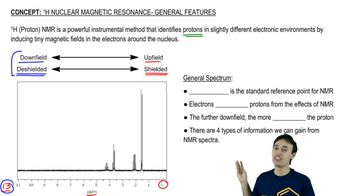
NMR spectroscopy is a powerful analytical technique used to determine the structure of organic compounds. It relies on the magnetic properties of certain nuclei, primarily hydrogen (1H) and carbon (13C), to provide information about the number of hydrogen atoms, their environment, and how they are connected. The chemical shift (δ) indicates the electronic environment of the nuclei, while the splitting patterns reveal the number of neighboring hydrogen atoms.
Recommended video:
Guided course
General NMR Features
Multiplet Splitting in NMR
In NMR, peaks can appear as multiplets due to the interaction of a nucleus with neighboring nuclei, a phenomenon known as spin-spin coupling. The complexity of the splitting pattern depends on the number of adjacent hydrogen atoms and their arrangement. Clean multiplets indicate simple coupling, while complex splitting suggests multiple interactions, often due to overlapping signals from different types of protons or conformational changes in the molecule.
Recommended video:
Guided course
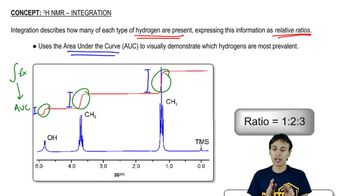
1H NMR Integration
Chemical Environment and Peak Integration
The chemical environment of protons affects their resonance frequency, leading to distinct peaks in an NMR spectrum. Peaks at different δ values correspond to protons in different electronic environments, influenced by factors like electronegativity and hybridization. Peak integration provides quantitative information about the number of protons contributing to each signal, which is essential for deducing the molecular formula and structure of the compound.
Recommended video:
Guided course
1H NMR Integration
Related Practice
Textbook Question
1
views
Textbook Question
Five proton NMR spectra are given here, together with molecular formulas. In each case, propose a structure that is consistent with the spectrum.
(b) <IMAGE>
2
views
Textbook Question
Give the spectral assignments for the protons in isobutyl alcohol (Solved Problem 13-4). For example, Ha is a singlet, area = 1, at δ2.4.
1
views
Textbook Question
Predict the theoretical number of different NMR signals produced by each compound, and give approximate chemical shifts. Point out any diastereotopic relationships.
c. Ph—CHBr—CH2Br
d. vinyl chloride
1
views
Textbook Question
Draw the expected NMR spectrum of methyl propionate, and point out how it differs from the spectrum of ethyl acetate.
1
views
Textbook Question
Propose mechanisms to show the interchange of protons between ethanol molecules under
(a) acid catalysis.
(b) base catalysis.
1
views