Ch. 27 - Carbohydrates, Nucleic Acids, and Lipids
Mullins - Organic Chemistry: A Learner Centered Approach 1st Edition
Mullins1st EditionOrganic Chemistry: A Learner Centered ApproachISBN: 9780137566471Not the one you use?Change textbook
Chapter 26, Problem 9b

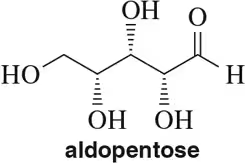
Convert each line-angle drawing, using appropriate bond rotations, into a correct Fischer projection.
(b) Structural representation of an aldopentose sugar with hydroxyl groups and a carbonyl group.

Verified step by step guidance
1
Identify the chiral centers in the line-angle drawing. In this aldopentose, there are three chiral centers, each carbon atom bonded to four different groups.
Determine the configuration (R or S) of each chiral center. This involves assigning priorities to the substituents based on atomic number and using the Cahn-Ingold-Prelog rules.
Visualize the molecule in a way that places the longest carbon chain vertically, with the most oxidized carbon (the aldehyde group) at the top. This is the standard orientation for Fischer projections.
Rotate the bonds around each chiral center to ensure that horizontal bonds in the Fischer projection represent bonds coming out of the plane (towards the viewer), while vertical bonds represent bonds going into the plane (away from the viewer).
Draw the Fischer projection by placing the substituents at each chiral center according to the bond rotations performed. Ensure that the stereochemistry matches the original line-angle drawing.

Verified video answer for a similar problem:

This video solution was recommended by our tutors as helpful for the problem above.
Video duration:
4m
Was this helpful?

Key Concepts

Here are the essential concepts you must grasp in order to answer the question correctly.

Line-Angle Drawing

Line-angle drawings, also known as skeletal structures, are a simplified way to represent organic molecules. In these diagrams, carbon atoms are implied at the ends and intersections of lines, and hydrogen atoms attached to carbons are not shown. This method is efficient for visualizing complex organic structures, such as sugars, by focusing on the connectivity of atoms.
Recommended video:
Guided course
02:46
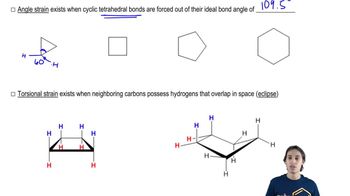
What is angle strain?

Fischer Projection

A Fischer projection is a two-dimensional representation of a three-dimensional organic molecule, often used for carbohydrates. In this projection, the molecule is oriented so that the carbon chain is vertical, with the most oxidized carbon at the top. Horizontal lines represent bonds projecting out of the plane towards the viewer, while vertical lines represent bonds going behind the plane.
Recommended video:
Guided course
09:56
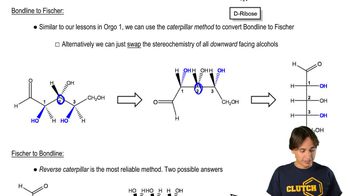
Monosaccharides - Drawing Fischer Projections

Bond Rotation

Bond rotation refers to the rotation around single bonds in a molecule, which can change the spatial arrangement of atoms without breaking any bonds. This concept is crucial when converting line-angle drawings to Fischer projections, as it allows for the correct orientation of substituents to match the projection's conventions, ensuring accurate representation of stereochemistry.
Recommended video:
Guided course
06:00
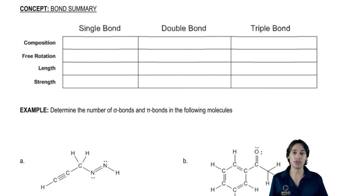
Single bonds, double bonds, and triple bonds.