Ch. 27 - Carbohydrates, Nucleic Acids, and Lipids
Mullins - Organic Chemistry: A Learner Centered Approach 1st Edition
Mullins1st EditionOrganic Chemistry: A Learner Centered ApproachISBN: 9780137566471Not the one you use?Change textbook
Chapter 26, Problem 12

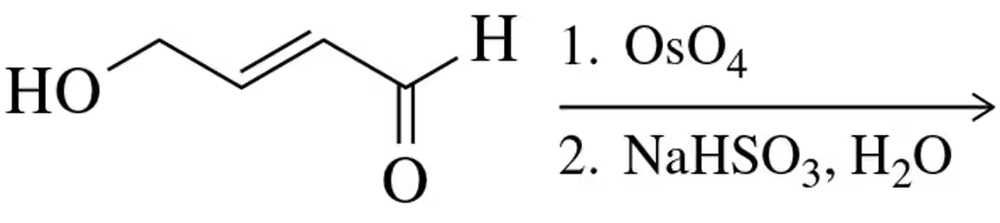
Draw the structure of and name the enantiomeric diols that result from the cis-dihydroxylation of the alkene shown.
Chemical structure showing cis-dihydroxylation of an alkene with reagents OsO4 and NaHSO3, H2O for diol formation.

Verified step by step guidance
1
Step 1: Analyze the reaction conditions. The reagents OsO₄ (osmium tetroxide) followed by NaHSO₃ (sodium bisulfite) and H₂O indicate a cis-dihydroxylation reaction. This reaction adds two hydroxyl groups (-OH) to the double bond of the alkene in a syn (same side) fashion.
Step 2: Identify the alkene in the given structure. The double bond is located between the second and third carbon atoms in the chain. This is the site where the cis-dihydroxylation will occur.
Step 3: Predict the stereochemistry of the product. Since the reaction is stereospecific, the two hydroxyl groups will be added to the same face of the double bond, resulting in a pair of enantiomers (mirror-image molecules).
Step 4: Draw the structures of the enantiomeric diols. For one enantiomer, the hydroxyl groups will be added to the same side of the double bond (e.g., both on the 'top' face). For the other enantiomer, the hydroxyl groups will be added to the opposite side (e.g., both on the 'bottom' face). Ensure the stereochemistry is clearly represented in the drawings.
Step 5: Name the enantiomeric diols. Use IUPAC nomenclature to name the compounds, ensuring to specify the stereochemistry (e.g., using R/S or D/L configurations) for each enantiomer. The names should reflect the positions and orientations of the hydroxyl groups added to the original alkene structure.

Verified video answer for a similar problem:

This video solution was recommended by our tutors as helpful for the problem above.
Was this helpful?

Key Concepts

Here are the essential concepts you must grasp in order to answer the question correctly.

Cis-Dihydroxylation

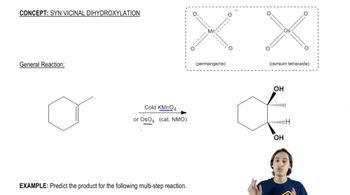
Cis-dihydroxylation is a chemical reaction that involves the addition of two hydroxyl (-OH) groups across a double bond in an alkene, resulting in a vicinal diol. This reaction typically occurs via syn addition, meaning that both hydroxyl groups are added to the same side of the double bond, leading to the formation of a specific stereochemical configuration.
Recommended video:
Guided course
03:50
General properties of syn vicinal dihydroxylation.

Enantiomers

Enantiomers are a type of stereoisomer that are non-superimposable mirror images of each other. They arise when a molecule has a chiral center, which is a carbon atom bonded to four different substituents. In the context of diols, the formation of enantiomeric pairs occurs when the addition of hydroxyl groups creates two distinct configurations that cannot be aligned with one another.
Recommended video:
Guided course
03:23
How to solve for the percentage of each enantiomer.

Chirality and Stereochemistry

Chirality refers to the geometric property of a molecule that makes it non-superimposable on its mirror image, often due to the presence of chiral centers. Stereochemistry is the study of the spatial arrangement of atoms in molecules and how this affects their chemical behavior. Understanding chirality is crucial for identifying and naming enantiomers, especially in reactions like cis-dihydroxylation where stereochemical outcomes are significant.
Recommended video:
1:21
Polymer Stereochemistry Example 1