Ch. 11 - Properties and Synthesis of Alkyl Halides: Radical Reactions
Mullins - Organic Chemistry: A Learner Centered Approach 1st Edition
Mullins1st EditionOrganic Chemistry: A Learner Centered ApproachISBN: 9780137566471Not the one you use?Change textbook
Chapter 10, Problem 18b

Using the bond-dissociation energies in Table 5.6,
(b) Will the transition state be reactant-like or product-like? Explain your answer.

Verified step by step guidance
1
Step 1: Understand the Hammond Postulate, which states that the structure of the transition state resembles the structure (reactants or products) that it is closer to in energy. This is key to determining whether the transition state is reactant-like or product-like.
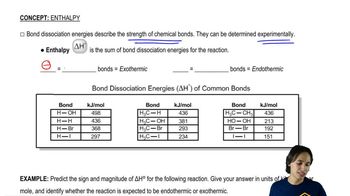
Step 2: Analyze the bond-dissociation energies (BDEs) provided in the table. Bond-dissociation energy is the energy required to break a bond into two fragments. Compare the BDEs of the bonds being broken and formed in the reaction to assess the energy difference between reactants and products.
Step 3: If the reaction is exothermic (products are lower in energy than reactants), the transition state will be closer in structure to the reactants. Conversely, if the reaction is endothermic (products are higher in energy than reactants), the transition state will resemble the products.
Step 4: Identify the specific bonds involved in the reaction (e.g., bonds being broken and formed). Use the BDE values from the table to calculate the overall energy change for the reaction. This will help determine whether the reaction is exothermic or endothermic.
Step 5: Based on the energy change and the Hammond Postulate, conclude whether the transition state is reactant-like or product-like. Provide reasoning based on the energy proximity of the transition state to either reactants or products.

Verified video answer for a similar problem:

This video solution was recommended by our tutors as helpful for the problem above.
Video duration:
5m
Was this helpful?

Key Concepts

Here are the essential concepts you must grasp in order to answer the question correctly.

Bond-Dissociation Energy

Bond-dissociation energy is the energy required to break a specific bond in a molecule, resulting in the formation of two radicals. It is a crucial concept in understanding the stability of reactants and products in a chemical reaction. Higher bond-dissociation energies indicate stronger bonds, which can influence the transition state of a reaction.
Recommended video:
Guided course
04:09
How to calculate enthalpy using bond dissociation energies.

Transition State

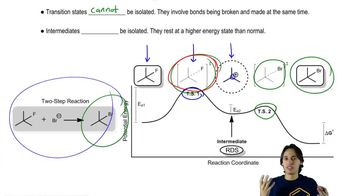
The transition state is a high-energy, unstable arrangement of atoms that occurs during the transformation from reactants to products. It represents the point of maximum energy along the reaction pathway and is critical for determining the reaction's rate and mechanism. Understanding whether the transition state is more similar to the reactants or products helps predict the reaction's favorability.
Recommended video:
Guided course
06:55
Intermediates vs. Transition States

Reactant-like vs. Product-like Transition States

A transition state is considered reactant-like if it resembles the structure of the reactants more than the products, typically occurring when the energy barrier to form products is high. Conversely, a product-like transition state resembles the products and indicates a lower energy barrier. Analyzing bond-dissociation energies can help determine the nature of the transition state and its implications for reaction kinetics.
Recommended video:
Guided course
01:47
Understanding “like dissolves like”.