Ch. 10 - Reactions of Alcohols, Ethers, Epoxides, Amines, and Sulfur-Containing Compounds
Bruice - Organic Chemistry 8th Edition
Bruice8th EditionOrganic ChemistryISBN: 9780135213711Not the one you use?Change textbook
Chapter 11, Problem 60a,b

What is the major product obtained from the reaction of 2-ethyloxirane with each of the following reagents?
a. 0.1MHCl 
b. CH3OH/HCl

Verified step by step guidance
1
Step 1: Understand the structure of 2-ethyloxirane. It is an epoxide, which is a three-membered cyclic ether. The ring is highly strained, making it reactive towards nucleophiles and acids.
Step 2: For part (a), when 2-ethyloxirane reacts with 0.1M HCl, the reaction proceeds via acid-catalyzed ring opening. The proton (H⁺) from HCl protonates the oxygen atom of the epoxide, increasing the electrophilicity of the carbon atoms in the ring.
Step 3: After protonation, the nucleophilic chloride ion (Cl⁻) attacks the more substituted carbon of the epoxide ring (following Markovnikov's rule), leading to the formation of a halohydrin. This step involves a regioselective ring-opening mechanism.
Step 4: For part (b), when 2-ethyloxirane reacts with CH₃OH in the presence of HCl, the reaction also proceeds via acid-catalyzed ring opening. The oxygen atom of the epoxide is protonated by H⁺, making the ring more susceptible to nucleophilic attack.
Step 5: The nucleophile in this case is methanol (CH₃OH). Methanol attacks the more substituted carbon of the epoxide ring (again following Markovnikov's rule), leading to the formation of a β-methoxy alcohol as the major product.

Verified video answer for a similar problem:

This video solution was recommended by our tutors as helpful for the problem above.
Video duration:
3m
Was this helpful?

Key Concepts

Here are the essential concepts you must grasp in order to answer the question correctly.

Epoxide Reactivity

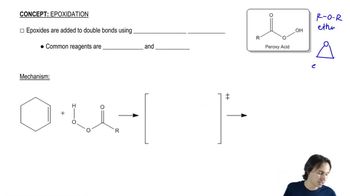
Epoxides, or oxiranes, are three-membered cyclic ethers that are highly reactive due to the strain in their ring structure. This strain makes them susceptible to nucleophilic attack, allowing them to undergo ring-opening reactions. The nature of the nucleophile and the reaction conditions can significantly influence the outcome of the reaction, leading to different products.
Recommended video:
Guided course
02:19
General properties of epoxidation.

Acid-Catalyzed Ring Opening

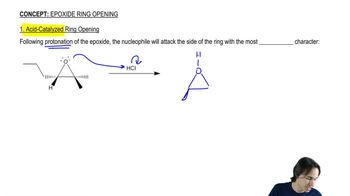
In the presence of an acid, such as HCl, epoxides can undergo ring-opening through protonation of the oxygen atom, which increases the electrophilicity of the carbon atoms in the epoxide. This process typically leads to the formation of a more stable carbocation intermediate, allowing for nucleophiles to attack and open the ring, resulting in the formation of alcohols or other functional groups.
Recommended video:
Guided course
04:34
Acid-Catalyzed Epoxide Ring-Opening

Nucleophilic Substitution Reactions

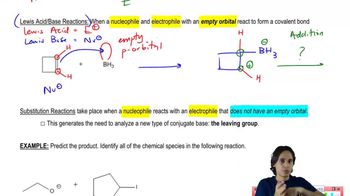
Nucleophilic substitution reactions involve the replacement of a leaving group by a nucleophile. In the context of the reaction with 2-ethyloxirane, the nucleophile (like CH3OH in the presence of HCl) attacks the more substituted carbon of the epoxide after the ring has been opened, leading to the formation of a product that retains the original carbon skeleton while introducing new functional groups.
Recommended video:
Guided course
01:47
Nucleophiles and Electrophiles can react in Substitution Reactions.