Ch. 10 - Reactions of Alcohols, Ethers, Epoxides, Amines, and Sulfur-Containing Compounds
Bruice - Organic Chemistry 8th Edition
Bruice8th EditionOrganic ChemistryISBN: 9780135213711Not the one you use?Change textbook
Chapter 11, Problem 60c

What is the major product obtained from the reaction of 2-ethyloxirane with each of the following reagents?
c. 0.1MNaOH

Verified step by step guidance
1
Identify the structure of 2-ethyloxirane. It is an epoxide (a three-membered cyclic ether) with an ethyl group attached to one of the carbons in the ring.
Understand the reactivity of epoxides in the presence of a base like NaOH. Epoxides are highly strained and reactive, and bases can open the ring via a nucleophilic attack.
Determine the site of nucleophilic attack. In basic conditions, the nucleophile (OH⁻) will attack the less substituted carbon of the epoxide due to steric hindrance and electronic effects.
Write the mechanism for the reaction. The OH⁻ attacks the less substituted carbon of the epoxide, breaking the C-O bond and opening the ring. This results in the formation of a diol (a molecule with two hydroxyl groups).
Assign the stereochemistry of the product. The nucleophilic attack occurs with inversion of configuration at the carbon being attacked, while the other carbon retains its configuration. Ensure the final product reflects this stereochemical outcome.

Verified video answer for a similar problem:

This video solution was recommended by our tutors as helpful for the problem above.
Video duration:
3m
Was this helpful?

Key Concepts

Here are the essential concepts you must grasp in order to answer the question correctly.

Epoxide Reactivity

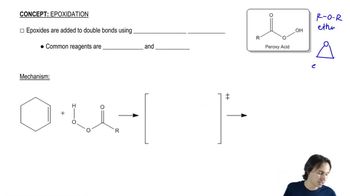
Epoxides, or oxiranes, are three-membered cyclic ethers that are highly reactive due to the strain in their ring structure. This strain makes them susceptible to nucleophilic attack, which can lead to ring-opening reactions. Understanding how epoxides react with nucleophiles is crucial for predicting the products of reactions involving them.
Recommended video:
Guided course
02:19
General properties of epoxidation.

Nucleophilic Substitution

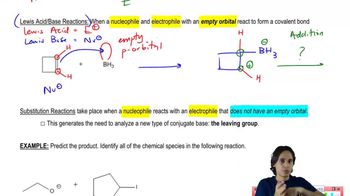
Nucleophilic substitution is a fundamental reaction mechanism in organic chemistry where a nucleophile replaces a leaving group in a molecule. In the case of epoxides, a nucleophile such as hydroxide ion (OH-) can attack the less hindered carbon atom of the epoxide, leading to the opening of the ring and the formation of an alcohol. This concept is essential for determining the major product of the reaction.
Recommended video:
Guided course
01:47
Nucleophiles and Electrophiles can react in Substitution Reactions.

Regioselectivity

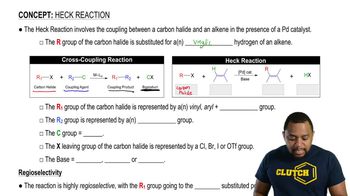
Regioselectivity refers to the preference of a chemical reaction to occur at one site over another in a molecule. In the context of epoxide reactions, the regioselectivity is influenced by steric and electronic factors, which dictate which carbon atom in the epoxide is attacked by the nucleophile. Understanding regioselectivity helps in predicting the specific product formed when 2-ethyloxirane reacts with NaOH.
Recommended video:
Guided course
05:09
Heck Reaction