
Ch.6 - Alkyl Halides; Nucleophilic Substitution
Wade - Organic Chemistry 9th Edition
Wade9th EditionOrganic ChemistryISBN: 9780135213728Not the one you use?Change textbook
Chapter 6, Problem 4a

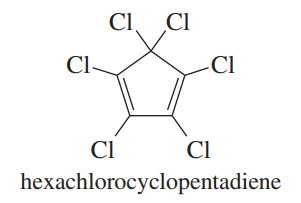
Kepone, aldrin, and chlordane are synthesized from hexachlorocyclopentadiene and other five-membered-ring compounds. Show how these three pesticides are composed of two five-membered rings.
Chemical structure of hexachlorocyclopentadiene, showing six chlorine atoms attached to a five-membered carbon ring.

Verified step by step guidance
1
Hexachlorocyclopentadiene is a five-membered ring compound with alternating double bonds and six chlorine atoms attached to the ring. This structure serves as a precursor for the synthesis of Kepone, aldrin, and chlordane.
To synthesize Kepone, hexachlorocyclopentadiene undergoes a reaction with another five-membered ring compound, typically through a Diels-Alder reaction. This reaction forms a bicyclic structure composed of two fused five-membered rings.
Aldrin is synthesized by reacting hexachlorocyclopentadiene with norbornadiene, another five-membered ring compound. The reaction forms a bicyclic structure where the two five-membered rings are fused together, with additional chlorine atoms attached to the structure.
Chlordane is synthesized by reacting hexachlorocyclopentadiene with cyclopentadiene, another five-membered ring compound. This reaction forms a bicyclic structure composed of two fused five-membered rings, with chlorine atoms attached to the rings.
In all three cases, the synthesis involves combining hexachlorocyclopentadiene with another five-membered ring compound to form a bicyclic structure. The resulting pesticides are characterized by their two fused five-membered rings and chlorine substituents, which contribute to their chemical properties and biological activity.

Verified video answer for a similar problem:

This video solution was recommended by our tutors as helpful for the problem above.
Video duration:
4m
Was this helpful?

Key Concepts

Here are the essential concepts you must grasp in order to answer the question correctly.

Five-Membered Rings

Five-membered rings are cyclic compounds consisting of five atoms, typically carbon, that form a closed loop. These structures can exhibit unique chemical properties and reactivity due to their ring strain and the spatial arrangement of substituents. In the context of pesticides like kepone, aldrin, and chlordane, understanding the formation and stability of these rings is crucial for analyzing their synthesis and behavior.
Recommended video:
Guided course
05:14
Ring Expansion

Hexachlorocyclopentadiene

Hexachlorocyclopentadiene is a chlorinated hydrocarbon with a five-membered carbon ring, where six chlorine atoms are attached to the ring. This compound serves as a precursor in the synthesis of various pesticides. Its structure is significant because the presence of multiple chlorine atoms influences the reactivity and stability of the resulting products, such as kepone, aldrin, and chlordane.

Pesticide Synthesis

Pesticide synthesis involves chemical reactions that convert precursor compounds into active pesticide ingredients. In this case, the transformation of hexachlorocyclopentadiene into pesticides like kepone, aldrin, and chlordane illustrates how specific chemical reactions can yield complex structures with biological activity. Understanding the mechanisms of these reactions is essential for grasping how these compounds function as pesticides.
Recommended video:
1:16
Synthesis of Amino Acids: Strecker Synthesis Example 1
Related Practice
Textbook Question

For each pair of compounds, predict which one has the higher molecular dipole moment, and explain your reasoning.

c. cis-2,3-dibromobut-2-ene or trans-2,3-dibromobut-2-ene

d. cis-1,2-dichlorocyclobutane or trans-1,3-dichlorocyclobutane

3
views
Textbook Question
The reaction of an amine with an alkyl halide gives an ammonium salt.R3N amine + R'—X alkyl halide —> R3(N+)—R' X- ammonium salt The rate of this SN2 reaction is sensitive to the polarity of the solvent. 1. Draw an energy diagram for this reaction in a nonpolar solvent and another in a polar solvent. 2. Consider the nature of the transition state, and explain why this reaction should be sensitive to the polarity of the solvent. 3. Predict whether it will be faster or slower in a more polar solvent.

1
views
Textbook Question

For each pair of compounds, predict which one has the higher molecular dipole moment, and explain your reasoning.

a. ethyl chloride or ethyl iodide

b. 1-bromopropane or cyclopropane

1
views
Textbook Question

For each of the following compounds,

1. give the IUPAC name.

2. give the common name (if possible).

3. classify the compound as a methyl, primary, secondary, or tertiary halide.

e.

1
views
Textbook Question

For each of the following compounds,

1. give the IUPAC name.

2. give the common name (if possible).

3. classify the compound as a methyl, primary, secondary, or tertiary halide.

(f)

5
views
Textbook Question

For each of the following compounds,

1. give the IUPAC name.

2. give the common name (if possible).

3. classify the compound as a methyl, primary, secondary, or tertiary halide.

c.

d.

1
views