Ch.6 - Alkyl Halides; Nucleophilic Substitution
Wade - Organic Chemistry 9th Edition
Wade9th EditionOrganic ChemistryISBN: 9780135213728Not the one you use?Change textbook
Chapter 6, Problem 3e

For each of the following compounds,
1. give the IUPAC name.
2. give the common name (if possible).
3. classify the compound as a methyl, primary, secondary, or tertiary halide.
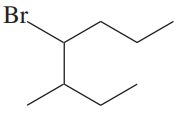
e. Structural formula of an alkyl halide with a bromine atom attached, illustrating its molecular arrangement.

Verified step by step guidance
1
Step 1: Identify the parent chain. The parent chain is the longest continuous chain of carbon atoms. In this case, the parent chain contains 5 carbon atoms, making it a pentane derivative.
Step 2: Number the parent chain. Start numbering from the end closest to the substituent (bromine atom) to give it the lowest possible number. The bromine atom is attached to carbon 2.
Step 3: Identify and name the substituents. There is a methyl group (-CH3) attached to carbon 3 of the parent chain.
Step 4: Combine the substituent names and the parent chain name. The IUPAC name is formed by listing the substituents in alphabetical order, followed by the parent chain name. The bromine substituent is named as 'bromo', and the methyl group is named as 'methyl'. The IUPAC name is 2-bromo-3-methylpentane.
Step 5: Classify the compound. The carbon atom bonded to the bromine atom is attached to two other carbon atoms, making it a secondary halide. The common name for this compound is sec-butyl bromide.

Verified video answer for a similar problem:

This video solution was recommended by our tutors as helpful for the problem above.
Video duration:
2m
Was this helpful?

Key Concepts

Here are the essential concepts you must grasp in order to answer the question correctly.

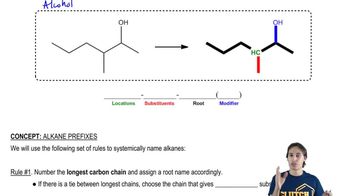
IUPAC Nomenclature

IUPAC nomenclature is a systematic method for naming organic chemical compounds. It provides a set of rules to create unique names based on the structure of the molecule, including the longest carbon chain, functional groups, and substituents. Understanding these rules is essential for accurately identifying and communicating the identity of compounds.
Recommended video:
Guided course
03:43
The different parts of an IUPAC name

Common Names

Common names are informal names used to identify chemical compounds, often based on historical or traditional usage rather than systematic rules. While IUPAC names are preferred for clarity, common names can be easier to remember and are widely recognized in certain contexts, such as 'ethyl alcohol' for ethanol. Knowing both names can enhance understanding and communication in organic chemistry.
Recommended video:
Guided course
06:06
Monosaccharides - Common Structures

Classification of Halides

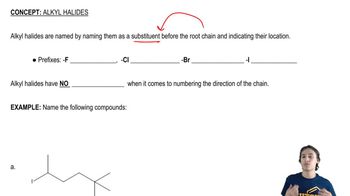
Halides are classified based on the carbon atom to which the halogen is attached. They can be categorized as methyl (attached to a methyl group), primary (attached to a primary carbon), secondary (attached to a secondary carbon), or tertiary (attached to a tertiary carbon). This classification is important for predicting reactivity and understanding the mechanisms of reactions involving these compounds.
Recommended video:
Guided course
01:52
How to name alkyl halides