Ch.10 - Structure and Synthesis of Alcohols
Wade - Organic Chemistry 9th Edition
Wade9th EditionOrganic ChemistryISBN: 9780135213728Not the one you use?Change textbook
Chapter 10, Problem 56b

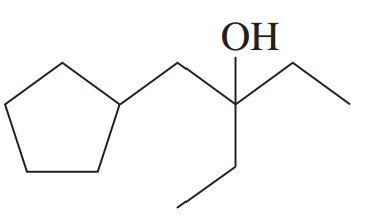
Often, compounds can be synthesized by more than one method. Show how this 3° alcohol can be made from the following:
Structural formula of a tertiary alcohol with an -OH group, illustrating synthesis from two different alkenes.
(b) two different alkenes

Verified step by step guidance
1
Step 1: Identify the target molecule as a tertiary alcohol (3° alcohol) with the hydroxyl group (-OH) attached to a carbon that is bonded to three other carbon atoms.
Step 2: Recognize that tertiary alcohols can be synthesized via the acid-catalyzed hydration of alkenes or hydroboration-oxidation reactions. The key is to select alkenes that will lead to the correct placement of the hydroxyl group.
Step 3: For the first alkene, consider an alkene where the double bond is between the tertiary carbon (where the -OH group will be attached) and one of its neighboring carbons. Acid-catalyzed hydration will add the -OH group to the more substituted carbon (Markovnikov addition). Example: 1-methylcyclopentene.
Step 4: For the second alkene, consider an alkene where the double bond is between the tertiary carbon and a different neighboring carbon. Hydroboration-oxidation can be used to add the -OH group to the less substituted carbon (anti-Markovnikov addition). Example: 2-methylcyclopentene.
Step 5: Ensure that the reaction conditions are appropriate for each synthesis method. For acid-catalyzed hydration, use H₂SO₄ and water. For hydroboration-oxidation, use BH₃ followed by H₂O₂ and NaOH.

Verified video answer for a similar problem:

This video solution was recommended by our tutors as helpful for the problem above.
Video duration:
3m
Was this helpful?

Key Concepts

Here are the essential concepts you must grasp in order to answer the question correctly.

Alcohol Synthesis

Alcohols can be synthesized through various methods, including hydration of alkenes, reduction of carbonyl compounds, and Grignard reactions. Understanding the mechanisms of these reactions is crucial for determining how to convert alkenes into alcohols effectively.
Recommended video:
Guided course
02:26
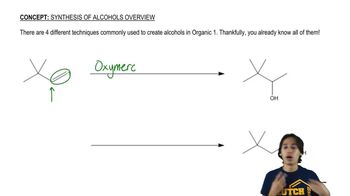
Forming alcohols through Oxymercuration-Reduction.

Alkene Reactivity

Alkenes are reactive due to the presence of a double bond, which can undergo various reactions such as electrophilic addition. The choice of alkene affects the regioselectivity and stereochemistry of the resulting alcohol, making it important to analyze the structure of the alkenes used in synthesis.
Recommended video:
2:09
Alkene Metathesis Concept 1

Regioselectivity and Stereochemistry

Regioselectivity refers to the preference of a chemical reaction to yield one structural isomer over others, while stereochemistry involves the spatial arrangement of atoms in molecules. Both concepts are essential when synthesizing alcohols from alkenes, as they influence the final product's properties and reactivity.
Recommended video:
1:38
Polymer Stereochemistry Concept 1