Ch.10 - Structure and Synthesis of Alcohols
Wade - Organic Chemistry 9th Edition
Wade9th EditionOrganic ChemistryISBN: 9780135213728Not the one you use?Change textbook
Chapter 10, Problem 56d

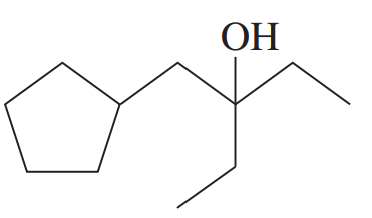
Often, compounds can be synthesized by more than one method. Show how this 3° alcohol can be made from the following:
Chemical structure of a tertiary alcohol with an -OH group, illustrating synthesis from a tertiary alkyl bromide.
(d) a 3° alkyl bromide

Verified step by step guidance
1
Step 1: Identify the target molecule, which is a tertiary alcohol. The structure provided shows a cyclopentyl group attached to a tertiary carbon that is bonded to an OH group.
Step 2: Recognize that tertiary alcohols can be synthesized via nucleophilic substitution reactions, where a tertiary alkyl halide reacts with a nucleophile such as hydroxide (OH⁻). In this case, the tertiary alkyl bromide will serve as the starting material.
Step 3: Determine the structure of the tertiary alkyl bromide. Replace the OH group in the target molecule with a bromine atom to form the tertiary alkyl bromide. This gives a compound where the bromine is attached to the same tertiary carbon.
Step 4: Plan the reaction. Use a strong nucleophile, such as aqueous NaOH or KOH, to perform an SN1 reaction. The tertiary alkyl bromide undergoes ionization to form a carbocation intermediate, which is then attacked by the hydroxide ion to form the tertiary alcohol.
Step 5: Consider reaction conditions. Since tertiary alkyl halides favor SN1 mechanisms, use polar protic solvents (e.g., water or alcohol) to stabilize the carbocation intermediate and facilitate the substitution reaction.

Verified video answer for a similar problem:

This video solution was recommended by our tutors as helpful for the problem above.
Video duration:
3m
Was this helpful?

Key Concepts

Here are the essential concepts you must grasp in order to answer the question correctly.

Nucleophilic Substitution

Nucleophilic substitution is a fundamental reaction in organic chemistry where a nucleophile replaces a leaving group in a molecule. In the case of synthesizing a 3° alcohol from a 3° alkyl bromide, the bromine atom acts as the leaving group, allowing a nucleophile, such as water or an alcohol, to attack the carbon atom, resulting in the formation of the alcohol.
Recommended video:
Guided course
01:47
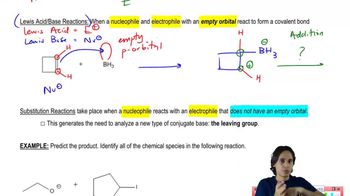
Nucleophiles and Electrophiles can react in Substitution Reactions.

Reactivity of Alkyl Halides

Alkyl halides, such as 3° alkyl bromides, are reactive compounds due to the polar C-X bond, where X is a halogen. The tertiary carbon is more stable and less sterically hindered for nucleophilic attack compared to primary or secondary alkyl halides, making them suitable substrates for nucleophilic substitution reactions that yield alcohols.
Recommended video:
Guided course
01:52
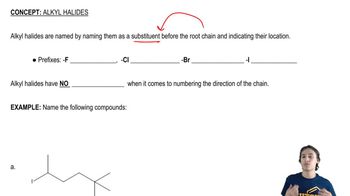
How to name alkyl halides

Mechanism of SN1 Reactions

The SN1 mechanism involves two steps: the formation of a carbocation intermediate after the leaving group departs, followed by the nucleophile attacking the carbocation. This mechanism is particularly relevant for 3° alkyl halides, as the stability of the carbocation allows for a more favorable reaction pathway, ultimately leading to the formation of the desired 3° alcohol.
Recommended video:
Guided course
10:49
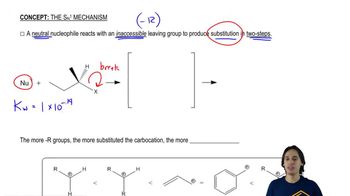
Drawing the SN1 Mechanism