

[18]-Annulene shows two signals in its 1H NMR spectrum: one at 9.25 ppm and the other to the right of the TMS signal at –2.88 ppm. What hydrogens are responsible for each of the signals? (Hint: Look at the direction of the induced magnetic field outside and inside the benzene ring in Figure 14.6.)
Ch. 14 - NMR Spectroscopy
Chapter 15, Problem 16
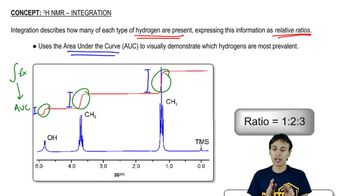
How would integration distinguish the 1H NMR spectra of the following compounds?

Verified step by step guidance1
Identify the compounds in question and determine the number of unique proton environments in each compound. Each unique environment corresponds to a distinct signal in the 1H NMR spectrum.
For each compound, analyze the relative number of protons contributing to each signal. This is determined by the symmetry and structure of the molecule. The integration of each signal in the 1H NMR spectrum is proportional to the number of protons in that environment.
Write the molecular formula for each compound and calculate the total number of hydrogens. Ensure that the sum of the integrals matches the total number of hydrogens in the molecule.
Compare the integration values for the signals in the spectra of the compounds. Differences in the relative ratios of the integrals will help distinguish between the compounds.
Consider any additional splitting patterns or chemical shift differences that might further differentiate the compounds, but focus primarily on the integration values to answer the question.

Verified video answer for a similar problem:
This video solution was recommended by our tutors as helpful for the problem above.
Video duration:
5mWas this helpful?
Key Concepts
Here are the essential concepts you must grasp in order to answer the question correctly.
Integration in NMR Spectroscopy
Integration in NMR spectroscopy refers to the area under the peaks in a 1H NMR spectrum, which correlates to the number of hydrogen atoms contributing to that signal. This allows chemists to determine the relative number of protons in different environments within a molecule, providing insight into the structure and composition of the compound.
Recommended video:
Guided course
1H NMR Integration
Chemical Shift
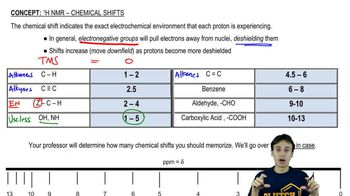
Chemical shift is a key concept in NMR that describes the position of a peak in the spectrum, measured in parts per million (ppm). It reflects the electronic environment surrounding the hydrogen atoms, influenced by factors such as electronegativity and hybridization, allowing for differentiation between protons in various chemical environments.
Recommended video:
Guided course
1H NMR Chemical Shifts
Multiplicity
Multiplicity in NMR refers to the splitting pattern of a signal, which indicates the number of neighboring protons (n) according to the n+1 rule. This provides information about the connectivity and arrangement of atoms in a molecule, helping to distinguish between different compounds based on their unique splitting patterns.
Recommended video:
Primary Structure of Nucleic Acids Concept 1
Related Practice
Textbook Question
1
views
Textbook Question
Draw a diagram like the one shown in Figure 14.12 to predict
a. the relative intensities of the peaks in a triplet.
<IMAGE>
2
views
Textbook Question
Without referring to Table 14.1, label the proton or set of protons in each compound that gives the signal at the lowest frequency a, at the next lowest b, and so on.
h.
1
views
Textbook Question
Without referring to Table 14.1, label the proton or set of protons in each compound that gives the signal at the lowest frequency a, at the next lowest b, and so on.
e.
3
views
Textbook Question
Which of the following compounds is responsible for the 1H NMR spectrum shown below?
<IMAGE>
5
views
Textbook Question
Explain how the following compounds, each with the same molecular formula, could be distinguished by their 1H NMR spectra.
1
views
