Ch. 20 - The Organic Chemistry of Carbohydrates
Bruice - Organic Chemistry 8th Edition
Bruice8th EditionOrganic ChemistryISBN: 9780135213711Not the one you use?Change textbook
Chapter 21, Problem 15a

What monosaccharides are formed in a modified Kiliani–Fischer synthesis starting with each of the following monosaccharides?
a. D-xylose

Verified step by step guidance
1
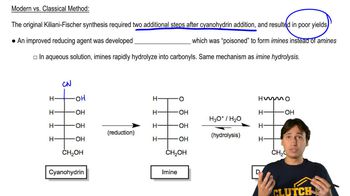
Step 1: Understand the Kiliani–Fischer synthesis. This reaction is used to lengthen the carbon chain of an aldose by one carbon atom, resulting in the formation of two epimeric aldoses (diastereomers) at the new chiral center. The process involves cyanohydrin formation, hydrolysis, and reduction.
Step 2: Identify the starting monosaccharide. d-Xylose is a five-carbon aldose (aldopentose) with the structure: CHO-(CHOH)3-CH2OH. It has three chiral centers, and its stereochemistry determines the configuration of the products.
Step 3: Add one carbon to the chain. In the first step of the Kiliani–Fischer synthesis, d-xylose reacts with HCN to form a cyanohydrin intermediate. This adds a new carbon atom to the chain, creating a six-carbon compound with a nitrile group (-C≡N) at the end.
Step 4: Hydrolyze the nitrile group. The cyanohydrin is hydrolyzed under acidic conditions to form an aldonic acid, which is then reduced to an aldehyde. This step introduces a new chiral center at the second carbon from the top, resulting in two possible epimers.
Step 5: Determine the products. The two epimeric aldohexoses formed are d-glucose and d-mannose. These are distinguished by the configuration of the hydroxyl group at the new chiral center (C-2).

Verified video answer for a similar problem:

This video solution was recommended by our tutors as helpful for the problem above.
Video duration:
6m
Was this helpful?

Key Concepts

Here are the essential concepts you must grasp in order to answer the question correctly.

Kiliani–Fischer Synthesis

The Kiliani–Fischer synthesis is a chemical reaction used to elongate monosaccharides by adding a carbon atom to the chain. This process involves the formation of an aldehyde from a sugar, followed by the addition of cyanide to create a cyanohydrin, which can then be hydrolyzed to yield a new aldose and a new ketose. It is particularly useful for synthesizing higher sugars from simpler ones.
Recommended video:
Guided course
03:57
Monosaccharides - Kiliani-Fischer

Monosaccharides

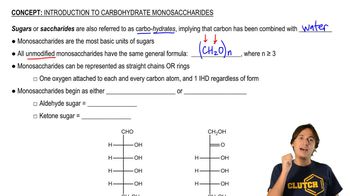
Monosaccharides are the simplest form of carbohydrates, consisting of single sugar units that cannot be hydrolyzed into simpler sugars. Common examples include glucose, fructose, and xylose. They serve as the building blocks for more complex carbohydrates and play crucial roles in energy metabolism and cellular functions.
Recommended video:
Guided course
12:01
Monosaccharide

Stereochemistry of Sugars

Stereochemistry refers to the spatial arrangement of atoms in molecules and is particularly important in organic chemistry for understanding the behavior of sugars. Monosaccharides can exist in different stereoisomeric forms, which can significantly affect their chemical properties and biological functions. For example, d-xylose and l-xylose are stereoisomers that differ in the configuration around one or more chiral centers.
Recommended video:
Guided course
08:42
Reducing Sugars