Ch. 20 - The Organic Chemistry of Carbohydrates
Bruice - Organic Chemistry 8th Edition
Bruice8th EditionOrganic ChemistryISBN: 9780135213711Not the one you use?Change textbook
Chapter 21, Problem 16a

What two monosaccharides can be degraded to
a. D-ribose? 

Verified step by step guidance
1
Understand the problem: The question is asking which two monosaccharides can be degraded to D-ribose. D-ribose is a five-carbon aldopentose sugar, so we need to identify monosaccharides that can undergo degradation reactions to yield this structure.
Recall the concept of monosaccharide degradation: Monosaccharides can undergo oxidative degradation or other chemical processes to lose carbon atoms and form smaller sugars. This typically involves the removal of one or more carbon atoms from the original sugar molecule.
Identify potential precursors: Look for monosaccharides that are structurally similar to D-ribose but have one or more additional carbon atoms. For example, a six-carbon sugar (hexose) or a five-carbon sugar with a different functional group arrangement could be degraded to D-ribose.
Consider specific examples: D-glucose and D-mannose are six-carbon aldoses that can be degraded to D-ribose through oxidative degradation pathways. Similarly, D-arabinose, a five-carbon aldose, can also be converted to D-ribose through epimerization reactions.
Verify the structural changes: Ensure that the degradation or epimerization reactions lead to the correct structure of D-ribose, which has the molecular formula C₅H₁₀O₅ and an aldehyde functional group at the first carbon.

Verified video answer for a similar problem:

This video solution was recommended by our tutors as helpful for the problem above.
Video duration:
5m
Was this helpful?

Key Concepts

Here are the essential concepts you must grasp in order to answer the question correctly.

Monosaccharides

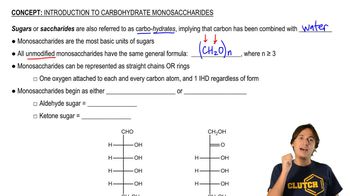
Monosaccharides are the simplest form of carbohydrates, consisting of single sugar molecules. They serve as the building blocks for more complex carbohydrates. Common examples include glucose, fructose, and ribose. Understanding their structure and function is essential for analyzing carbohydrate metabolism and degradation.
Recommended video:
Guided course
12:01
Monosaccharide

Degradation of Carbohydrates

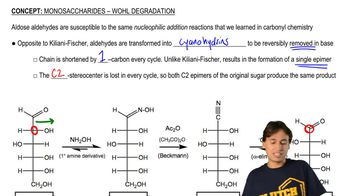
Carbohydrate degradation refers to the biochemical processes that break down complex carbohydrates into simpler sugars or monosaccharides. This process is crucial for energy production in living organisms. Enzymatic reactions, such as hydrolysis, play a significant role in this degradation, allowing for the conversion of polysaccharides into usable monosaccharides like d-ribose.
Recommended video:
Guided course
09:43
Monosaccharides - Wohl Degradation

D-Ribose

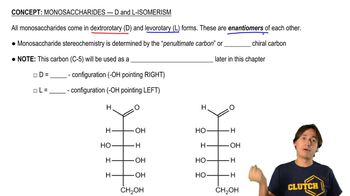
D-Ribose is a five-carbon sugar (pentose) that is a key component of RNA and plays a vital role in cellular metabolism. It is involved in the synthesis of ATP, the energy currency of the cell. Understanding its structure and metabolic pathways is important for recognizing how it can be derived from other monosaccharides through degradation processes.
Recommended video:
Guided course
06:47
Monosaccharides - D and L Isomerism