Ch. 4 - Isomers: The Arrangement of Atoms in Space
Bruice - Organic Chemistry 8th Edition
Bruice8th EditionOrganic ChemistryISBN: 9780135213711Not the one you use?Change textbook
Chapter 5, Problem 32

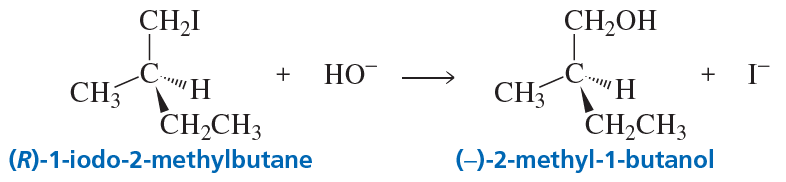
The reaction of (R)-1-iodo-2-methylbutane with hydroxide ion forms an alcohol without breaking any bonds to the asymmetric center. The alcohol rotates the plane of polarization of plane-polarized light counterclockwise. What is the configuration of (+)-2-methyl-1-butanol?
Reaction of (R)-1-iodo-2-methylbutane with hydroxide ion forming (−)-2-methyl-1-butanol and illustrating optical activity.

Verified step by step guidance
1
Step 1: Analyze the reaction mechanism. The reaction involves the substitution of the iodine atom in (R)-1-iodo-2-methylbutane with a hydroxide ion (OH⁻) to form an alcohol. This substitution occurs via an SN2 mechanism, which results in inversion of configuration at the carbon where substitution occurs.
Step 2: Determine the stereochemistry of the starting material. The starting material, (R)-1-iodo-2-methylbutane, has the (R)-configuration at the asymmetric center. Since the SN2 reaction causes inversion, the product will have the opposite configuration, which is (S)-2-methyl-1-butanol.
Step 3: Understand the relationship between optical activity and stereochemistry. The problem states that the alcohol rotates plane-polarized light counterclockwise, which corresponds to a negative rotation (denoted as (-)). Optical rotation is not directly related to the R/S configuration but is experimentally determined.
Step 4: Clarify the configuration of (+)-2-methyl-1-butanol. The (+) sign indicates that the compound rotates plane-polarized light clockwise. Since the product of the reaction is (S)-2-methyl-1-butanol, the configuration of (+)-2-methyl-1-butanol must be (R), as the optical rotation is independent of the reaction mechanism.
Step 5: Conclude that the configuration of (+)-2-methyl-1-butanol is (R). This conclusion is based on the inversion of configuration during the SN2 reaction and the experimental observation of optical rotation.

Verified video answer for a similar problem:

This video solution was recommended by our tutors as helpful for the problem above.
Video duration:
3m
Was this helpful?

Key Concepts

Here are the essential concepts you must grasp in order to answer the question correctly.

Stereochemistry

Stereochemistry is the study of the spatial arrangement of atoms in molecules and how this affects their chemical behavior. In this context, the configuration of chiral centers is crucial, as it determines the optical activity of the compound. The terms 'R' and 'S' denote specific configurations based on the Cahn-Ingold-Prelog priority rules, which help in identifying the three-dimensional orientation of substituents around a chiral carbon.

Optical Activity

Optical activity refers to the ability of a chiral compound to rotate the plane of polarized light. The direction of rotation can be either clockwise (dextrorotatory, +) or counterclockwise (levorotatory, -). In this question, the alcohol formed from the reaction is noted to rotate light counterclockwise, indicating it is a levorotatory compound, which is essential for determining its configuration as (+)-2-methyl-1-butanol.

Nucleophilic Substitution Reactions

Nucleophilic substitution reactions involve the replacement of a leaving group in a molecule by a nucleophile. In this case, hydroxide ion acts as the nucleophile that attacks the carbon atom bonded to the iodine in (R)-1-iodo-2-methylbutane, leading to the formation of an alcohol. Understanding the mechanism of this reaction, whether it proceeds via an SN1 or SN2 pathway, is vital for predicting the stereochemical outcome of the product.