Ch. 5 - Chemical Reaction Analysis: Thermodynamics and Kinetics
Mullins - Organic Chemistry: A Learner Centered Approach 1st Edition
Mullins1st EditionOrganic Chemistry: A Learner Centered ApproachISBN: 9780137566471Not the one you use?Change textbook
Chapter 4, Problem 15a

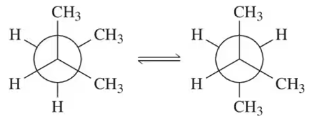
Calculate ∆H° for the following equilibrium processes.
(a)

Verified step by step guidance
1
Analyze the chemical structures provided in the image. The equilibrium process involves the interconversion of two conformations of cyclohexane: one with axial methyl groups and the other with equatorial methyl groups.
Understand that the energy difference between these conformations arises due to steric hindrance. Axial methyl groups experience 1,3-diaxial interactions, which increase the energy of the axial conformation compared to the equatorial conformation.
To calculate ∆H°, determine the energy difference between the axial and equatorial conformations. This can be done using known values for the steric strain caused by 1,3-diaxial interactions for methyl groups.
Use the standard enthalpy change formula: ∆H° = (Energy of axial conformation) - (Energy of equatorial conformation). Substitute the appropriate values for the steric strain energy.
Interpret the result: A negative ∆H° indicates that the equatorial conformation is more stable, which is expected due to reduced steric hindrance.

Verified video answer for a similar problem:

This video solution was recommended by our tutors as helpful for the problem above.
Was this helpful?

Key Concepts

Here are the essential concepts you must grasp in order to answer the question correctly.

Enthalpy Change (∆H°)

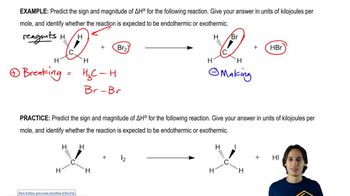
Enthalpy change (∆H°) is a measure of the heat content of a system at constant pressure. It indicates whether a reaction is exothermic (releases heat, ∆H° < 0) or endothermic (absorbs heat, ∆H° > 0). Understanding how to calculate ∆H° is crucial for analyzing chemical reactions and their energy profiles.
Recommended video:
Guided course
04:38
Calculating Enthalpies

Equilibrium Processes

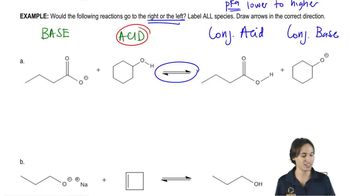
Equilibrium processes refer to the state in which the rates of the forward and reverse reactions are equal, resulting in constant concentrations of reactants and products. The equilibrium constant (K) can be used to relate the concentrations of species at equilibrium, and changes in enthalpy can affect the position of equilibrium according to Le Chatelier's principle.
Recommended video:
Guided course
04:00
Determining Acid/Base Equilibrium

Hess's Law

Hess's Law states that the total enthalpy change for a reaction is the sum of the enthalpy changes for individual steps, regardless of the pathway taken. This principle allows for the calculation of ∆H° for complex reactions by breaking them down into simpler steps, making it essential for determining the enthalpy changes in equilibrium processes.
Recommended video:
1:39
The Beer-Lambert Law Concept 2