Ch. 10 - Reactions of Alcohols, Ethers, Epoxides, Amines, and Sulfur-Containing Compounds
Bruice - Organic Chemistry 8th Edition
Bruice8th EditionOrganic ChemistryISBN: 9780135213711Not the one you use?Change textbook
Chapter 11, Problem 24e

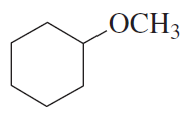
What are the major products obtained when each of the following ethers is heated with one equivalent of HI?
e. Cyclohexane structure with a methoxy group (OCH3) attached, illustrating ether cleavage reaction.

Verified step by step guidance
1
Identify the structure of the ether in question. Ethers have the general formula R-O-R', where R and R' are alkyl or aryl groups. Determine the specific groups attached to the oxygen atom in the given ether.
Understand the reaction mechanism: When an ether reacts with HI, the bond between the oxygen and one of the alkyl groups (R or R') is cleaved. This occurs via an SN2 or SN1 mechanism, depending on the nature of the alkyl groups. Primary and secondary alkyl groups typically undergo SN2, while tertiary alkyl groups favor SN1.
Determine which bond will break: The bond between the oxygen and the less sterically hindered alkyl group (or the group that forms a more stable carbocation in the case of SN1) is more likely to break. This results in the formation of an alcohol (R-OH) and an alkyl iodide (R'-I).
Write the products: After the bond cleavage, one product will be an alcohol (R-OH) formed from the group still attached to the oxygen, and the other product will be an alkyl iodide (R'-I) formed from the group that was cleaved.
Verify the stoichiometry: Since one equivalent of HI is used, ensure that only one ether bond is cleaved, resulting in the formation of one molecule of alcohol and one molecule of alkyl iodide as the major products.

Verified video answer for a similar problem:

This video solution was recommended by our tutors as helpful for the problem above.
Video duration:
3m
Was this helpful?

Key Concepts

Here are the essential concepts you must grasp in order to answer the question correctly.

Ethers

Ethers are organic compounds characterized by an oxygen atom connected to two alkyl or aryl groups. They are generally stable and non-reactive under normal conditions but can undergo cleavage in the presence of strong acids, such as hydroiodic acid (HI). Understanding the structure and reactivity of ethers is crucial for predicting the products formed during their reaction with HI.
Recommended video:
Guided course
04:22
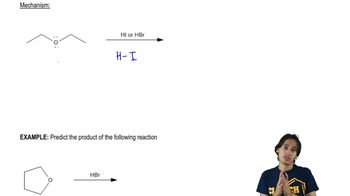
How to predict the products of Ether Cleavage.

Acid-Catalyzed Cleavage

Acid-catalyzed cleavage of ethers involves the protonation of the ether oxygen, making the ether bond more susceptible to nucleophilic attack. When heated with HI, the ether is cleaved to form an alcohol and an alkyl iodide. This reaction is significant in organic synthesis as it allows for the generation of useful products from relatively stable starting materials.
Recommended video:
Guided course
03:09
Acid Catalyzed

Reaction Mechanism

The reaction mechanism for ether cleavage by HI typically involves a bimolecular nucleophilic substitution (SN2) pathway. In this mechanism, the iodide ion acts as a nucleophile, attacking the carbon atom bonded to the ether oxygen after the ether is protonated. Understanding this mechanism is essential for predicting the major products and their formation during the reaction.
Recommended video:
Guided course
02:16
Heck Reaction Mechanism