Ch.3 - Structure and Stereochemistry of Alkanes
Wade - Organic Chemistry 9th Edition
Wade9th EditionOrganic ChemistryISBN: 9780135213728Not the one you use?Change textbook
Chapter 3, Problem 22a

Draw 1,2,3,4,5,6-hexamethylcyclohexane with all the methyl groups
a. in axial positions.

Verified step by step guidance
1
Step 1: Begin by drawing the basic structure of cyclohexane, which is a six-membered ring. Cyclohexane typically adopts a chair conformation to minimize steric strain.
Step 2: Label the carbon atoms in the ring from 1 to 6 to keep track of the positions where the methyl groups will be added.
Step 3: Recall that in the chair conformation, each carbon atom has two substituent positions: one axial (pointing straight up or down) and one equatorial (pointing outward and slightly angled). For this problem, all methyl groups will be placed in axial positions.
Step 4: Add a methyl group (CH₃) to the axial position of each carbon atom in the ring. Use dashed or solid wedges to indicate whether the axial position is pointing up or down, depending on the orientation of the chair conformation.
Step 5: Double-check your drawing to ensure that all six methyl groups are correctly placed in axial positions and that the chair conformation is accurately represented. Verify that the structure adheres to the rules of stereochemistry and avoids any errors in bond placement.

Verified video answer for a similar problem:

This video solution was recommended by our tutors as helpful for the problem above.
Video duration:
2m
Was this helpful?

Key Concepts

Here are the essential concepts you must grasp in order to answer the question correctly.

Cyclohexane Conformation

Cyclohexane can adopt different conformations, primarily chair and boat forms. The chair conformation is the most stable due to minimized steric strain. In this conformation, substituents can occupy either axial (pointing up or down) or equatorial (pointing outward) positions, affecting the overall stability of the molecule.
Recommended video:
Guided course
03:29
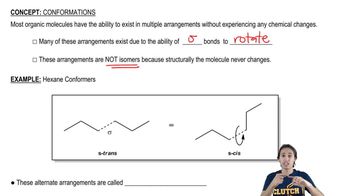
Understanding what a conformer is.

Axial vs. Equatorial Positions

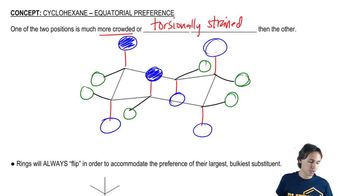
In cyclohexane derivatives, substituents can be positioned axially or equatorially. Axial substituents are aligned parallel to the axis of the ring, while equatorial substituents extend outward from the ring. Axial positions can lead to 1,3-diaxial interactions, increasing steric strain and making the molecule less stable compared to when substituents are in equatorial positions.
Recommended video:
Guided course
04:02
Equatorial Preference

Steric Hindrance

Steric hindrance refers to the repulsion between atoms that occurs when they are brought close together, often due to the size of the substituents. In the case of 1,2,3,4,5,6-hexamethylcyclohexane, placing all methyl groups in axial positions increases steric hindrance, leading to greater strain and a less stable conformation compared to a configuration with equatorial methyl groups.
Recommended video:
Guided course
02:53
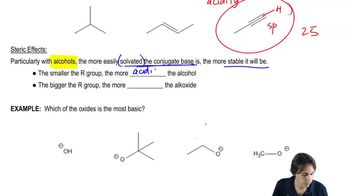
Understanding steric effects.
Related Practice
Textbook Question

Draw 1,2,3,4,5,6-hexamethylcyclohexane with all the methyl groups

b. in equatorial positions.

7
views

Textbook Question

Table 3-6 shows that the axial–equatorial energy difference for methyl, ethyl, and isopropyl groups increases gradually: 7.6, 7.9, and 8.8 kJ/mol (1.8, 1.9, and 2.1 kcal/mol). The tert-butyl group jumps to an energy difference of 23 kJ/mol (5.4 kcal/mol), over twice the value for the isopropyl group. Draw pictures of the axial conformations of isopropylcyclohexane and tert-butylcyclohexane, and explain why the tert-butyl substituent experiences such a large increase in axial energy over the isopropyl group.

4
views
Textbook Question

The heat of combustion of cis-1,2-dimethylcyclopropane is larger than that of the trans isomer. Which isomer is more stable? Use drawings to explain this difference in stability.

2
views
Textbook Question

trans-1,2-Dimethylcyclobutane is more stable than cis-1,2-dimethylcyclobutane, but cis-1,3-dimethylcyclobutane is more stable than trans-1,3-dimethylcyclobutane. Use drawings to explain these observations.

2
views
Textbook Question

Draw a Newman projection, similar to Figure 3-25 down the C1—C6 bond in the ­equatorial conformation of methylcyclohexane. Show that the equatorial methyl group is also anti to C5. (Using your models will help.)

<IMAGE>

1
views
Textbook Question

The cyclohexane chair shown in Figure 3-22 has the headrest to the right and the footrest to the left. Draw a cyclohexane chair with its axial and equatorial bonds, showing the headrest to the left and the footrest to the right.

2
views