
Textbook Question
Propose a mechanism for the base-promoted hydrolysis of γ-butyrolactone:
2
views

 Verified step by step guidance
 03:06
03:06
 01:25
01:25 10:06
10:06Propose a mechanism for the base-promoted hydrolysis of γ-butyrolactone:
Explain why we speak of acidic hydrolysis of an ester as acid-catalyzed, but of basic hydrolysis as base-promoted.
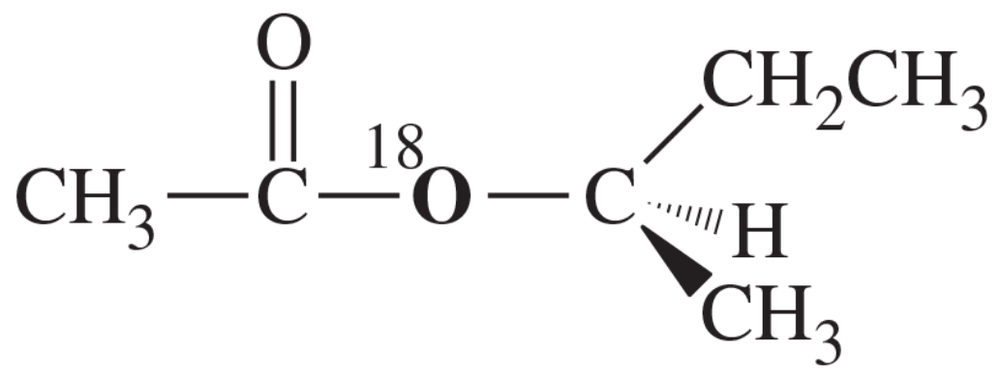
Suppose we have some optically pure (R)-2-butyl acetate that has been "labeled" with the heavy 18O isotope at one oxygen atom as shown.
(b) Repeat part (a) for the acid-catalyzed hydrolysis of this compound.
Soap manufacturers always use base to hydrolyze fats, and never acid. Suggest two reasons that basic hydrolysis is preferred.
1. Propose a mechanism for the acid-catalyzed reaction of salicylic acid with acetic anhydride.
2. Explain why a single drop of sulfuric acid dramatically increases the reaction rate.
Suppose we have some optically pure (R)-2-butyl acetate that has been 'labeled' with the heavy 18O isotope at one oxygen atom as shown.
(a) Draw a mechanism for the hydrolysis of this compound under basic conditions. Predict which of the products will contain the 18O label. Also predict whether the butan-2-ol product will be pure (R), pure (S), or racemized.