Ch. 21 - Carboxylic Acid Derivatives
Wade - Organic Chemistry 9th Edition
Wade9th EditionOrganic ChemistryISBN: 9780135213728Not the one you use?Change textbook
Chapter 21, Problem 17a

Explain why we speak of acidic hydrolysis of an ester as acid-catalyzed, but of basic hydrolysis as base-promoted.

Verified step by step guidance
1
Understand the difference between a catalyst and a promoter: A catalyst speeds up a reaction without being consumed, while a promoter is a substance that enhances the reaction but may be consumed in the process.
For acidic hydrolysis of an ester, recognize that the acid acts as a catalyst. The acid donates a proton to the ester, making the carbonyl carbon more electrophilic and susceptible to nucleophilic attack by water. The acid is regenerated at the end of the reaction, so it is not consumed.
For basic hydrolysis of an ester (also called saponification), note that the base (e.g., hydroxide ion, OH⁻) is consumed in the reaction. The hydroxide ion directly attacks the carbonyl carbon of the ester, breaking the bond and forming a carboxylate ion and an alcohol.
Explain why the term 'base-promoted' is used: Since the base is consumed in the reaction and is not regenerated, it is not acting as a catalyst. Instead, it promotes the reaction by participating as a reactant.
Summarize the distinction: Acidic hydrolysis is acid-catalyzed because the acid is regenerated, while basic hydrolysis is base-promoted because the base is consumed during the reaction.

Verified video answer for a similar problem:

This video solution was recommended by our tutors as helpful for the problem above.
Video duration:
6m
Was this helpful?

Key Concepts

Here are the essential concepts you must grasp in order to answer the question correctly.

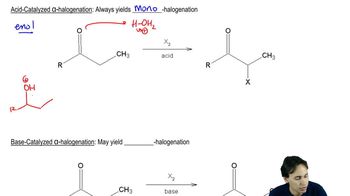
Acid-Catalyzed Hydrolysis

Acid-catalyzed hydrolysis of esters involves the addition of an acid, typically a strong acid like hydrochloric acid, which donates protons (H+) to the reaction. This protonation of the ester enhances its electrophilicity, making it more susceptible to nucleophilic attack by water. The term 'catalyzed' indicates that the acid is not consumed in the reaction; it merely facilitates the process by lowering the activation energy.
Recommended video:
Guided course
03:09
Acid Catalyzed

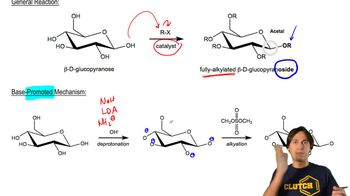
Base-Promoted Hydrolysis

In contrast, base-promoted hydrolysis of esters involves the use of a base, such as sodium hydroxide, which provides hydroxide ions (OH-) that directly attack the ester. This process is termed 'promoted' because the base is consumed in the reaction, forming a carboxylate ion and alcohol. The term emphasizes the role of the base in driving the reaction forward rather than merely facilitating it.
Recommended video:
Guided course
04:04
Base-Promoted Mechanism

Mechanistic Differences

The mechanistic differences between acid-catalyzed and base-promoted hydrolysis are crucial for understanding their terminology. Acid-catalyzed reactions typically proceed through a protonation step that activates the ester, while base-promoted reactions involve nucleophilic attack by hydroxide ions. Recognizing these mechanisms helps clarify why the terms 'catalyzed' and 'promoted' are used differently, reflecting the distinct roles of acids and bases in these hydrolysis reactions.
Recommended video:
Guided course
01:41
Different atoms or different connectivity.