Ch. 14 - NMR Spectroscopy
Bruice - Organic Chemistry 8th Edition
Bruice8th EditionOrganic ChemistryISBN: 9780135213711Not the one you use?Change textbook
Chapter 15, Problem 73

Calculate the amount of energy (in calories) required to flip an 1H nucleus in an NMR spectrometer that operates at 300 MHz.

Verified step by step guidance
1
Understand the relationship between the energy required to flip a nucleus and the frequency of the NMR spectrometer. The energy difference (ΔE) between the two spin states of a nucleus in a magnetic field is given by the equation: ΔE=hν, where h is Planck's constant and ν is the frequency of the spectrometer.
Substitute the given frequency of the NMR spectrometer, 300 MHz, into the equation. Convert the frequency from MHz to Hz by multiplying by 106.
Use the value of Planck's constant, h=6.626×10⁻³⁴ \(\text{ J·s}\), to calculate the energy difference in joules. Multiply h by the frequency in Hz.
Convert the energy from joules to calories. Use the conversion factor: 1 \(\text{ calorie}\) = 4.184 \(\text{ joules}\). Divide the energy in joules by 4.184 to obtain the energy in calories.
Verify the units and ensure the final value is expressed in calories. This will give the amount of energy required to flip the 1H nucleus in the NMR spectrometer operating at 300 MHz.

Verified video answer for a similar problem:

This video solution was recommended by our tutors as helpful for the problem above.
Video duration:
10m
Was this helpful?

Key Concepts

Here are the essential concepts you must grasp in order to answer the question correctly.

Nuclear Magnetic Resonance (NMR)

Nuclear Magnetic Resonance (NMR) is a spectroscopic technique used to observe the magnetic properties of atomic nuclei. In NMR, nuclei in a magnetic field absorb and re-emit electromagnetic radiation, allowing for the determination of molecular structure. The frequency of the NMR spectrometer, measured in megahertz (MHz), indicates the strength of the magnetic field and influences the energy required to flip the nuclear spin states.
Recommended video:
Guided course
04:00
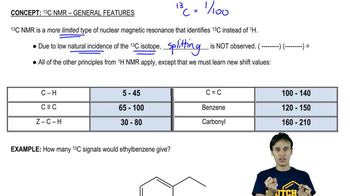
13C NMR General Features

Energy of a Spin Transition

The energy required to flip a nucleus from its lower energy state to a higher energy state in NMR is determined by the relationship between the magnetic field strength and the frequency of the radiation. This energy can be calculated using the formula E = hν, where E is energy, h is Planck's constant, and ν is the frequency of the applied electromagnetic radiation. For a 1H nucleus at 300 MHz, this energy corresponds to the energy difference between the two spin states.
Recommended video:
Guided course
06:55
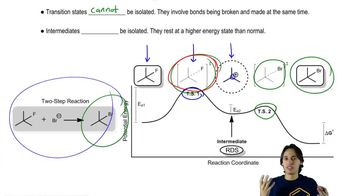
Intermediates vs. Transition States

Planck's Constant

Planck's constant (h) is a fundamental constant in quantum mechanics that relates the energy of a photon to its frequency. It has a value of approximately 6.626 x 10^-34 J·s. In the context of NMR, it is essential for calculating the energy required for nuclear spin transitions, as it provides the proportionality factor between energy and frequency, allowing for the conversion of energy units from joules to calories when necessary.
Recommended video:
Guided course
02:19
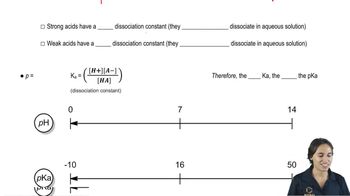
The relationship between equilibrium constant and pKa.