Ch. 15 - Structural Identification II: Nuclear Magnetic Resonance Spectroscopy
Mullins - Organic Chemistry: A Learner Centered Approach 1st Edition
Mullins1st EditionOrganic Chemistry: A Learner Centered ApproachISBN: 9780137566471Not the one you use?Change textbook
Chapter 14, Problem 43

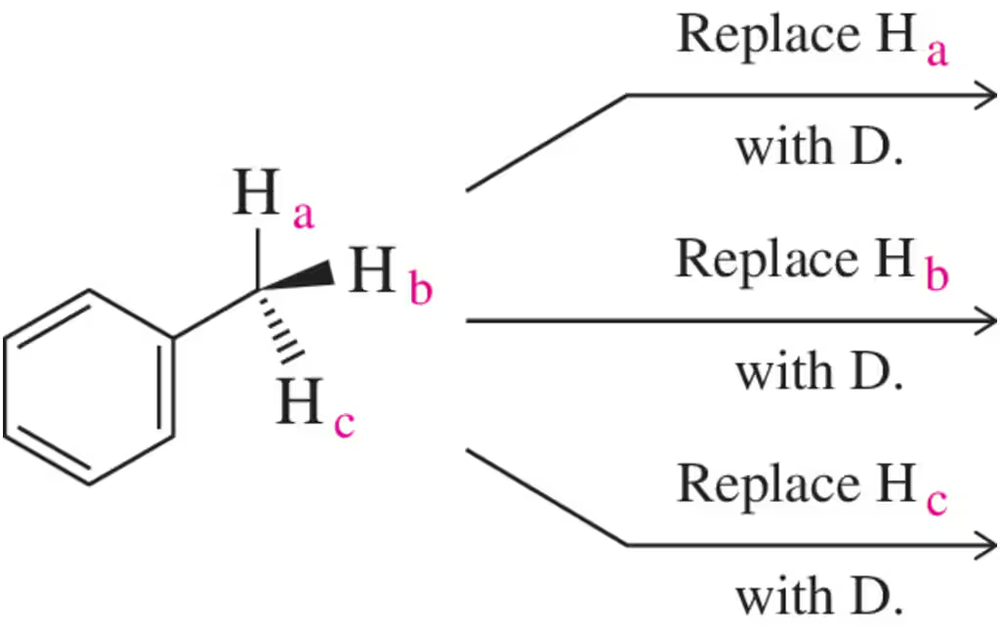
Replace Hₐ, H₆, and H꜀ in methyl benzene with a deuterium. What is the relationship between the three products you obtain? Based on this, how many signals would you expect for these hydrogens in the ¹H NMR spectrum?
Diagram showing methyl benzene with Hₐ, H₆, H꜀ replaced by deuterium, illustrating ¹H NMR signal prediction.

Verified step by step guidance
1
Identify the structure of methyl benzene, also known as toluene. It consists of a benzene ring with a methyl group (CH₃) attached to it.
Recognize that Hₐ, H₆, and H꜀ refer to different hydrogen atoms on the benzene ring. In toluene, these hydrogens are located at different positions relative to the methyl group: ortho (Hₐ), meta (H₆), and para (H꜀).
Replace each of these hydrogens with deuterium (D), which is an isotope of hydrogen. This results in three different deuterated toluene molecules: ortho-deuterated, meta-deuterated, and para-deuterated toluene.
Determine the relationship between the three deuterated products. Since the benzene ring is symmetrical, the ortho, meta, and para positions are chemically distinct, leading to different chemical environments for each deuterium substitution.
Predict the number of signals in the ¹H NMR spectrum. Each unique chemical environment for the hydrogens in the original toluene will result in a separate signal. Consider the symmetry and the effect of the methyl group on the chemical shift of each hydrogen position.

Verified video answer for a similar problem:

This video solution was recommended by our tutors as helpful for the problem above.
Video duration:
5m
Was this helpful?

Key Concepts

Here are the essential concepts you must grasp in order to answer the question correctly.

Isotopic Substitution

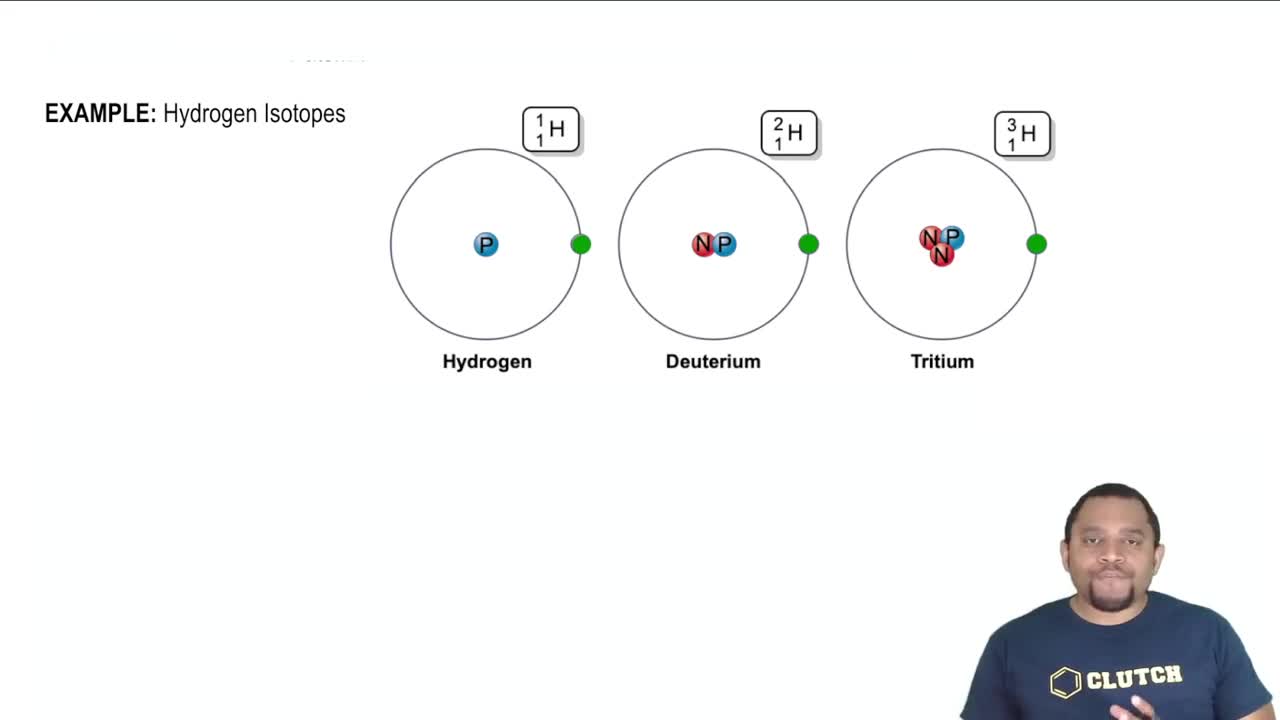
Isotopic substitution involves replacing an atom in a molecule with its isotope, such as replacing hydrogen (H) with deuterium (D). This substitution can affect the physical and chemical properties of the molecule, including its behavior in spectroscopic analysis, due to the difference in mass between isotopes.
Recommended video:
Guided course
03:06
Understanding the hydrogen isotopes.

NMR Spectroscopy

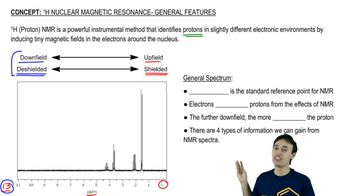
Nuclear Magnetic Resonance (NMR) Spectroscopy is a technique used to observe the local environment of nuclei in a molecule. In ¹H NMR, hydrogen atoms in different chemical environments produce distinct signals. The number of signals corresponds to the number of unique hydrogen environments in the molecule.
Recommended video:
Guided course
10:06
General NMR Features

Chemical Equivalence

Chemical equivalence refers to atoms or groups in a molecule that are in identical environments and thus indistinguishable by NMR. In methyl benzene, the symmetry of the molecule can lead to some hydrogens being chemically equivalent, resulting in fewer NMR signals than the total number of hydrogens.
Recommended video:
3:11
Chemical Reactions of Phosphate Anhydrides Concept 1