Replace Hₐ, H₆, and H꜀ in methyl benzene with a deuterium. What is the relationship between the three products you obtain? Based on this, how many signals would you expect for these hydrogens in the ¹H NMR spectrum?
Ch. 15 - Structural Identification II: Nuclear Magnetic Resonance Spectroscopy

Mullins1st EditionOrganic Chemistry: A Learner Centered ApproachISBN: 9780137566471Not the one you use?Change textbook
All textbooks
Mullins 1st Edition
Ch. 15 - Structural Identification II: Nuclear Magnetic Resonance Spectroscopy
Problem 45b
Mullins 1st Edition
Ch. 15 - Structural Identification II: Nuclear Magnetic Resonance Spectroscopy
Problem 45bChapter 14, Problem 45b
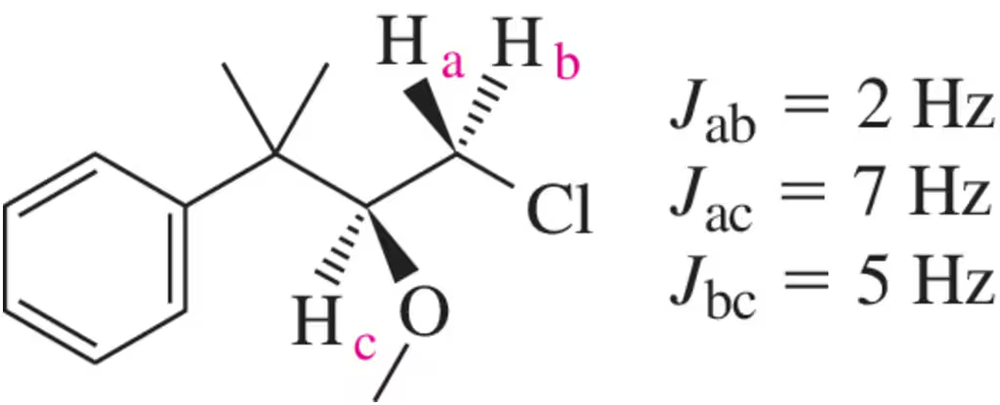
Sketch the signals you would expect to see for Hb in the molecule shown. The important coupling constants are given.

Verified step by step guidance1
Identify the hydrogen atom labeled as H₆ in the molecular structure provided. This will be the focus of our analysis.
Determine the chemical environment of H₆. Consider factors such as the type of carbon it is attached to, the presence of electronegative atoms, and any resonance effects that might influence its chemical shift.
Analyze the coupling constants provided. These constants will help you understand the splitting pattern of the H₆ signal. For example, if H₆ is coupled to two neighboring hydrogens with a coupling constant of 7 Hz, it will appear as a triplet.
Consider the multiplicity of the signal for H₆. Use the n+1 rule, where n is the number of neighboring hydrogens, to predict the splitting pattern. For instance, if H₆ is adjacent to two equivalent hydrogens, the signal will be a triplet.
Sketch the expected NMR signal for H₆, taking into account its chemical shift, multiplicity, and the coupling constants. Label the peaks according to their relative intensities and positions based on the coupling information.

Verified video answer for a similar problem:
This video solution was recommended by our tutors as helpful for the problem above.
Was this helpful?
Key Concepts
Here are the essential concepts you must grasp in order to answer the question correctly.
NMR Spectroscopy
Nuclear Magnetic Resonance (NMR) Spectroscopy is a technique used to determine the structure of organic compounds by observing the magnetic properties of atomic nuclei. In NMR, hydrogen atoms (protons) in a molecule produce signals that can be analyzed to deduce information about the molecular structure, including the number of hydrogen environments and their electronic surroundings.
Recommended video:
Guided course
General NMR Features
Chemical Shift
Chemical shift refers to the position of an NMR signal, measured in parts per million (ppm), which indicates the electronic environment of a nucleus. It is influenced by the electronegativity of nearby atoms and the magnetic field experienced by the nucleus. Understanding chemical shifts helps in identifying the types of hydrogen atoms present in a molecule and their relative positions.
Recommended video:
Guided course
1H NMR Chemical Shifts
Spin-Spin Coupling
Spin-spin coupling, or J-coupling, occurs when the magnetic field of one nucleus affects the magnetic field of a neighboring nucleus, causing splitting of NMR signals into multiplets. The coupling constant (J) measures the strength of this interaction in hertz (Hz). Analyzing coupling patterns and constants helps in determining the connectivity and spatial arrangement of atoms within a molecule.
Recommended video:
Guided course
Sonogashira Coupling Reaction
Related Practice
Textbook Question
6
views
Textbook Question
How many signals would you expect in the ¹³C NMR spectrum of each molecule shown?
(b)
1
views
Textbook Question
How many signals would you expect in the ¹³C NMR spectrum of each molecule shown?
(c)
4
views
Textbook Question
Replace Hₐ and H₆ in acetone with a deuterium. What is the relationship between the two products you obtain? Based on this, would you expect the two hydrogens to give one or two signals in the ¹H NMR spectrum?
9
views
Textbook Question
Sketch the signals you would expect to see for H꜀ in the molecule shown. The important coupling constants are given.
3
views
Textbook Question
Sketch the signals you would expect to see for Hₐ in the molecule shown. The important coupling constants are given.
2
views