Ch. 21 - Carboxylic Acid Derivatives
Wade - Organic Chemistry 9th Edition
Wade9th EditionOrganic ChemistryISBN: 9780135213728Not the one you use?Change textbook
Chapter 21, Problem 50g

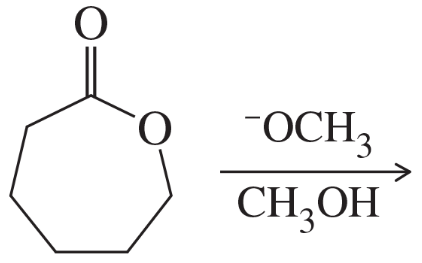
Predict the products of the following reactions.
(g)

Verified step by step guidance
1
Step 1: Analyze the first reaction. The reactant is a cyclic ester (lactone) and the reagents are methoxide ion (-OCH3) and methanol (CH3OH). This indicates a nucleophilic acyl substitution reaction, where the methoxide ion attacks the carbonyl carbon of the ester.
Step 2: In the first reaction, the methoxide ion (-OCH3) acts as a nucleophile and attacks the electrophilic carbonyl carbon of the lactone. This leads to the opening of the ring and formation of a carboxylate intermediate.
Step 3: The carboxylate intermediate formed in the first reaction is then protonated by methanol (CH3OH), resulting in the formation of a methyl ester and an alcohol as the final products.
Step 4: Analyze the second reaction. The reactant is the same cyclic ester (lactone), but the reagents are excess phenylmagnesium bromide (PhMgBr) followed by acid workup (H3O+). This indicates a Grignard reaction, where the Grignard reagent adds to the carbonyl group.
Step 5: In the second reaction, the Grignard reagent (PhMgBr) adds twice to the carbonyl carbon of the lactone due to the excess reagent. This results in the formation of a tertiary alcohol after the acid workup step (H3O+), with two phenyl groups attached to the carbon originally part of the carbonyl group.

Verified video answer for a similar problem:

This video solution was recommended by our tutors as helpful for the problem above.
Video duration:
2m
Was this helpful?

Key Concepts

Here are the essential concepts you must grasp in order to answer the question correctly.

Nucleophilic Acyl Substitution

Nucleophilic acyl substitution is a fundamental reaction in organic chemistry where a nucleophile attacks a carbonyl carbon, leading to the replacement of a leaving group. In the context of the provided reaction, methanol acts as the nucleophile, attacking the carbonyl carbon of the cyclic compound, resulting in the formation of an ester. This mechanism is crucial for understanding how carboxylic acid derivatives react with nucleophiles.
Recommended video:
Guided course
01:47
Nucleophiles and Electrophiles can react in Substitution Reactions.

Reactivity of Carbonyl Compounds

Carbonyl compounds, such as aldehydes and ketones, are highly reactive due to the polarized carbon-oxygen double bond. The carbon atom is electrophilic, making it susceptible to nucleophilic attack. In the given reaction, the presence of two carbonyl groups in the cyclic compound enhances its reactivity, allowing for the formation of new bonds with nucleophiles like methanol.
Recommended video:
Guided course
01:40
Defining meso compounds.

Grignard Reagents

Grignard reagents are organomagnesium compounds that act as strong nucleophiles in organic reactions. They can react with various electrophiles, including carbonyl compounds, to form alcohols. In the second reaction depicted, the excess PhMgBr reacts with a carboxylic acid derivative, leading to the formation of a tertiary alcohol after hydrolysis. Understanding the behavior of Grignard reagents is essential for predicting the outcomes of reactions involving carbonyl compounds.
Recommended video:
Guided course
02:12
Carbonation of Grignard Reagents