Ch. 21 - Carboxylic Acid Derivatives
Wade - Organic Chemistry 9th Edition
Wade9th EditionOrganic ChemistryISBN: 9780135213728Not the one you use?Change textbook
Chapter 21, Problem 50h

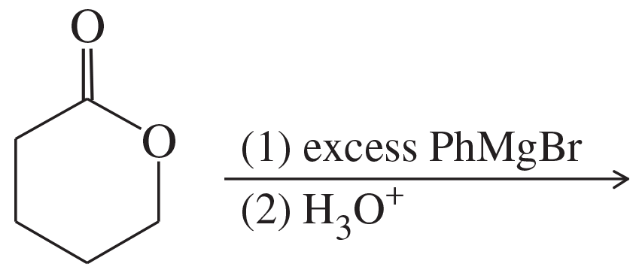
Predict the products of the following reactions:.
(h)

Verified step by step guidance
1
Step 1: Identify the functional groups in the starting material. The molecule contains a cyclic ester (lactone) functional group, which is reactive towards nucleophiles like Grignard reagents.
Step 2: Recognize the reagent used. PhMgBr is a phenyl Grignard reagent, which acts as a nucleophile and attacks electrophilic carbon atoms, such as the carbonyl carbon in the ester group.
Step 3: Predict the first reaction step. The Grignard reagent will attack the carbonyl carbon of the ester, breaking the C=O bond and forming a tetrahedral intermediate. Since excess PhMgBr is used, the intermediate will react further, leading to the cleavage of the ester bond and formation of a secondary alcohol.
Step 4: Consider the second reaction step. After the Grignard reagent reacts, the addition of H3O+ (acidic workup) will protonate the oxygen atoms, stabilizing the product and completing the reaction.
Step 5: Predict the final product. The reaction will yield a tertiary alcohol where two phenyl groups (Ph) are attached to the carbon that was originally part of the carbonyl group in the ester. The cyclic structure will open due to the cleavage of the ester bond.

Verified video answer for a similar problem:

This video solution was recommended by our tutors as helpful for the problem above.
Video duration:
2m
Was this helpful?

Key Concepts

Here are the essential concepts you must grasp in order to answer the question correctly.

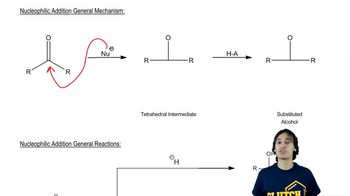
Nucleophilic Addition Reactions

Nucleophilic addition reactions involve the attack of a nucleophile on an electrophilic carbon atom, typically found in carbonyl groups. In this case, the phenylmagnesium bromide (PhMgBr) acts as a nucleophile, attacking the carbonyl carbon of the cyclic compound. This reaction leads to the formation of an alkoxide intermediate, which can be protonated in a subsequent step to yield an alcohol.
Recommended video:
Guided course
08:27
Nucleophilic Addition

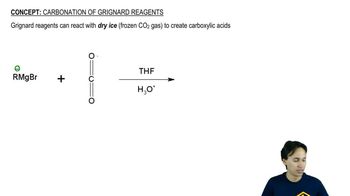
Grignard Reagents

Grignard reagents, such as phenylmagnesium bromide (PhMgBr), are organomagnesium compounds that are highly reactive nucleophiles. They are used to form carbon-carbon bonds by attacking electrophilic centers, such as carbonyls. The excess of Grignard reagent in this reaction indicates that it will react with both carbonyl groups in the cyclic compound, leading to the formation of a tertiary alcohol after protonation.
Recommended video:
Guided course
02:12
Carbonation of Grignard Reagents

Protonation of Alkoxides

After the nucleophilic addition of a Grignard reagent to a carbonyl compound, the resulting alkoxide intermediate must be protonated to form the final alcohol product. This is typically achieved by adding a proton source, such as dilute acid (H3O+), which donates a proton to the negatively charged oxygen of the alkoxide. This step is crucial for converting the intermediate into a stable alcohol, completing the reaction.
Recommended video:
Guided course
03:
Proton Splitting