Ch. 25 - Amines: Structure, Reactions, and Synthesis
Mullins - Organic Chemistry: A Learner Centered Approach 1st Edition
Mullins1st EditionOrganic Chemistry: A Learner Centered ApproachISBN: 9780137566471Not the one you use?Change textbook
Chapter 24, Problem 20

Which would you expect to be a stronger nucleophile, ethyl amine or diethyl amine? Why?

Verified step by step guidance
1
Understand the concept of nucleophilicity: Nucleophilicity refers to the ability of a molecule to donate a pair of electrons to an electrophile. It is influenced by factors such as charge, electronegativity, steric hindrance, and the solvent.
Identify the structures of ethyl amine and diethyl amine: Ethyl amine is \( \text{CH}_3\text{CH}_2\text{NH}_2 \) and diethyl amine is \( \text{(CH}_3\text{CH}_2\text{)}_2\text{NH} \). Both contain nitrogen atoms with lone pairs that can act as nucleophiles.
Consider the effect of alkyl groups on nucleophilicity: Alkyl groups are electron-donating, which can increase the electron density on the nitrogen atom, enhancing its nucleophilicity.
Evaluate steric hindrance: Diethyl amine has two ethyl groups attached to the nitrogen, which can create more steric hindrance compared to ethyl amine, potentially affecting its ability to approach and react with electrophiles.
Compare the overall nucleophilicity: While diethyl amine has more electron-donating groups, the increased steric hindrance may reduce its nucleophilicity compared to ethyl amine. Consider these factors to determine which is the stronger nucleophile.

Verified video answer for a similar problem:

This video solution was recommended by our tutors as helpful for the problem above.
Video duration:
2m
Was this helpful?

Key Concepts

Here are the essential concepts you must grasp in order to answer the question correctly.

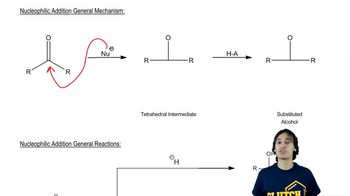
Nucleophilicity

Nucleophilicity refers to the ability of a chemical species to donate a pair of electrons to an electrophile, forming a chemical bond. It is influenced by factors such as charge, electronegativity, steric hindrance, and the solvent. In general, a stronger nucleophile is more reactive and can more readily form bonds with electrophiles.
Recommended video:
Guided course
08:27
Nucleophilic Addition

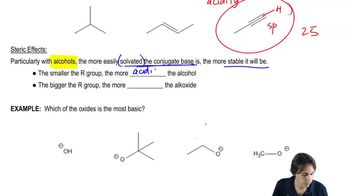
Steric Hindrance

Steric hindrance occurs when the size of groups within a molecule prevents chemical reactions that are otherwise possible. In the context of nucleophilicity, larger substituents around the nucleophilic center can impede its ability to approach and react with an electrophile, thus reducing its nucleophilic strength.
Recommended video:
Guided course
02:53
Understanding steric effects.

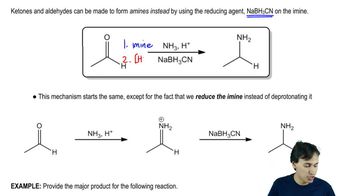
Amine Structure and Basicity

Amines are organic compounds derived from ammonia, characterized by the presence of a nitrogen atom bonded to alkyl or aryl groups. The basicity of amines is influenced by the availability of the lone pair on nitrogen for bonding. In comparing ethyl amine and diethyl amine, the number and type of alkyl groups attached to the nitrogen can affect both steric hindrance and electron-donating effects, impacting nucleophilicity.
Recommended video:
Guided course
07:12
Reductive Amination