Ch. 25 - Amines: Structure, Reactions, and Synthesis
Mullins - Organic Chemistry: A Learner Centered Approach 1st Edition
Mullins1st EditionOrganic Chemistry: A Learner Centered ApproachISBN: 9780137566471Not the one you use?Change textbook
Chapter 24, Problem 25c

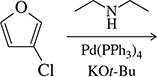
Predict the product of the following reactions.
(c) Chemical reaction diagram showing a chlorinated aromatic compound reacting with a palladium catalyst and base to form an amine.

Verified step by step guidance
1
Identify the type of reaction: The presence of Pd(PPh3)4 and KOt-Bu suggests a Buchwald-Hartwig amination reaction, which is used to form carbon-nitrogen bonds.
Analyze the reactants: The starting materials include a chlorinated furan and a secondary amine. The furan ring is a five-membered aromatic ring containing an oxygen atom, and the amine is diethylamine.
Understand the mechanism: In Buchwald-Hartwig amination, the palladium catalyst facilitates the coupling of the aryl halide (chlorinated furan) with the amine. The base (KOt-Bu) deprotonates the amine, making it a better nucleophile.
Predict the product: The nitrogen atom of the deprotonated amine will attack the carbon atom bonded to the chlorine in the furan ring, resulting in the formation of a new C-N bond and the release of a chloride ion.
Consider the regioselectivity: Since the reaction involves a single chlorinated position on the furan, the amine will substitute at this position, leading to the formation of an N-aryl amine product with the furan ring intact.

Verified video answer for a similar problem:

This video solution was recommended by our tutors as helpful for the problem above.
Video duration:
2m
Was this helpful?

Key Concepts

Here are the essential concepts you must grasp in order to answer the question correctly.

Palladium-Catalyzed Cross-Coupling Reactions

Palladium-catalyzed cross-coupling reactions are a class of reactions that form carbon-carbon or carbon-heteroatom bonds using a palladium catalyst. In this reaction, Pd(PPh3)4 is used to facilitate the coupling between an aryl halide and an amine, leading to the formation of a new C-N bond. This process is crucial in organic synthesis for constructing complex molecules efficiently.
Recommended video:
Guided course
03:20
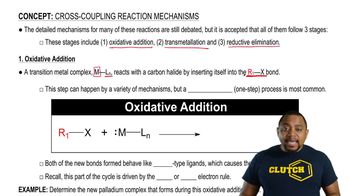
Cross-Coupling Reaction Mechanisms

Buchwald-Hartwig Amination

The Buchwald-Hartwig amination is a specific type of palladium-catalyzed cross-coupling reaction where an amine is coupled with an aryl halide to form an aryl amine. This reaction typically requires a palladium catalyst, a ligand, and a base. In the given reaction, the amine is introduced to the chlorinated aromatic compound, resulting in the substitution of the chlorine atom with the amine group.
Recommended video:
Guided course
03:46
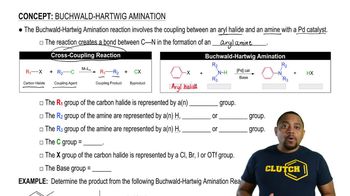
Buchwald-Hartwig Amination Reaction

Role of Base in Cross-Coupling Reactions

Bases play a critical role in cross-coupling reactions by deprotonating the amine, which enhances its nucleophilicity, allowing it to effectively attack the aryl halide. In this reaction, KOt-Bu (potassium tert-butoxide) serves as the base, facilitating the formation of the C-N bond by activating the amine and stabilizing the palladium complex during the catalytic cycle.
Recommended video:
Guided course
03:22
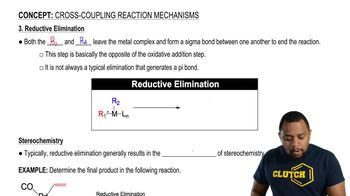
Cross-Coupling Reaction Mechanisms