Ch.3 - Structure and Stereochemistry of Alkanes
Wade - Organic Chemistry 9th Edition
Wade9th EditionOrganic ChemistryISBN: 9780135213728Not the one you use?Change textbook
Chapter 3, Problem 14

Draw a perspective representation of the most stable conformation of 3-methylhexane.

Verified step by step guidance
1
Identify the structure of 3-methylhexane. It is a six-carbon chain (hexane) with a methyl group attached to the third carbon.
Draw the carbon backbone of hexane in a zigzag pattern, which is the most common way to represent alkanes in their staggered conformation.
Locate the third carbon in the chain and attach a methyl group (CH₃) to it. Ensure that the methyl group is positioned in a way that minimizes steric hindrance with other groups.
Consider the staggered conformation for the carbon-carbon bonds, as this is generally more stable than the eclipsed conformation due to reduced torsional strain.
Use wedge and dash bonds to represent the three-dimensional arrangement of the atoms. Wedge bonds indicate bonds coming out of the plane towards the viewer, while dash bonds indicate bonds going behind the plane. Arrange the groups around each carbon to minimize steric hindrance and achieve the most stable conformation.

Verified video answer for a similar problem:

This video solution was recommended by our tutors as helpful for the problem above.
Video duration:
2m
Was this helpful?

Key Concepts

Here are the essential concepts you must grasp in order to answer the question correctly.

Conformational Analysis

Conformational analysis involves studying the different spatial arrangements of atoms in a molecule that result from rotation around single bonds. For alkanes like 3-methylhexane, identifying the most stable conformation requires understanding how steric hindrance and torsional strain affect molecular stability.
Recommended video:
Guided course
03:29
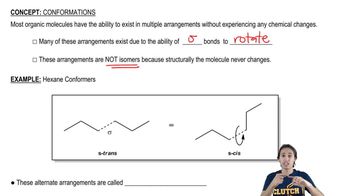
Understanding what a conformer is.

Newman Projection

A Newman projection is a method used to visualize the conformation of a molecule by looking down the axis of a bond. This representation helps in identifying the most stable conformation by showing the spatial arrangement of substituents, allowing for the assessment of steric interactions and torsional strain.
Recommended video:
Guided course
00:34
Introduction to Drawing Newman Projections

Steric Hindrance

Steric hindrance refers to the repulsion between atoms or groups of atoms due to their size, which can affect the stability of a molecule's conformation. In 3-methylhexane, the positioning of the methyl group relative to other substituents is crucial in determining the most stable conformation, as minimizing steric hindrance leads to greater stability.
Recommended video:
Guided course
02:53
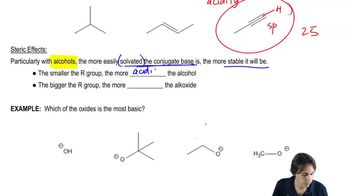
Understanding steric effects.