Ch.3 - Structure and Stereochemistry of Alkanes
Wade - Organic Chemistry 9th Edition
Wade9th EditionOrganic ChemistryISBN: 9780135213728Not the one you use?Change textbook
Chapter 3, Problem 16c,d

Draw the structure and give the molecular formula for each of the following compounds.
c. cyclopropylcyclopentane
d. 3-ethyl-1,1-dimethylcyclohexane

Verified step by step guidance
1
Step 1: Understand the naming conventions for organic compounds. Cyclopropylcyclopentane consists of a cyclopropyl group attached to a cyclopentane ring. Cyclopropyl is a three-carbon ring, and cyclopentane is a five-carbon ring.
Step 2: Draw the cyclopentane ring first. Cyclopentane is a five-membered ring, so sketch a pentagon to represent this structure.
Step 3: Attach the cyclopropyl group to the cyclopentane ring. Cyclopropyl is a three-membered ring, typically attached to one of the carbon atoms in the cyclopentane ring. Draw a triangle to represent the cyclopropyl group and connect it to the cyclopentane ring.
Step 4: For 3-ethyl-1,1-dimethylcyclohexane, start by drawing the cyclohexane ring, which is a six-membered ring. Sketch a hexagon to represent this structure.
Step 5: Add the substituents to the cyclohexane ring. Place the ethyl group (CH₃CH₂-) at the third carbon and two methyl groups (CH₃-) at the first carbon. Ensure the correct placement of these groups according to the IUPAC naming conventions.

Verified video answer for a similar problem:

This video solution was recommended by our tutors as helpful for the problem above.
Video duration:
6m
Was this helpful?

Key Concepts

Here are the essential concepts you must grasp in order to answer the question correctly.

Cycloalkanes

Cycloalkanes are saturated hydrocarbons with carbon atoms arranged in a ring structure. They are named based on the number of carbon atoms in the ring, such as cyclopropane (3 carbons) and cyclopentane (5 carbons). Understanding cycloalkanes is crucial for drawing and identifying the structure of compounds like cyclopropylcyclopentane.
Recommended video:
Guided course
01:11
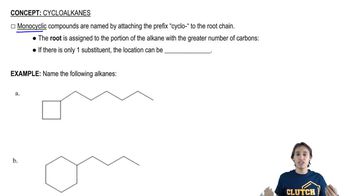
How to find the root name for cycloalkanes

IUPAC Nomenclature

IUPAC nomenclature is a systematic method for naming organic compounds. It involves identifying the longest carbon chain, numbering the carbon atoms, and naming substituents. For example, in 3-ethyl-1,1-dimethylcyclohexane, the cyclohexane ring is the main structure, with ethyl and dimethyl groups as substituents at specified positions.
Recommended video:
Guided course
03:43
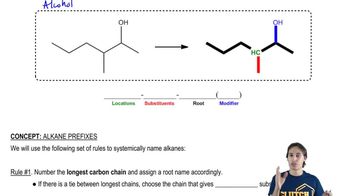
The different parts of an IUPAC name

Substituents and Positioning

Substituents are groups attached to the main carbon chain or ring in a molecule. Their position is indicated by numbers, which are assigned based on the lowest possible numbering from the main structure. In 3-ethyl-1,1-dimethylcyclohexane, the ethyl group is at position 3, and the dimethyl groups are at position 1, affecting the molecular structure and formula.
Recommended video:
4:06
Reactions at the Allylic Position Example 3