Ch. 5 - Chemical Reaction Analysis: Thermodynamics and Kinetics
Mullins - Organic Chemistry: A Learner Centered Approach 1st Edition
Mullins1st EditionOrganic Chemistry: A Learner Centered ApproachISBN: 9780137566471Not the one you use?Change textbook
Chapter 4, Problem 2a

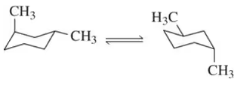
Predict which side of the equilibrium is favored for each of the chair–chair interconversions (ring flips) shown.
(a)

Verified step by step guidance
1
Step 1: Analyze the chair conformations shown in the image. In the first chair conformation, the methyl group (CH₃) is in the axial position, while in the second chair conformation, the methyl group is in the equatorial position.
Step 2: Recall that substituents in the equatorial position experience less steric hindrance compared to those in the axial position. This is due to the fact that axial substituents interact with other axial groups on the same side of the ring (1,3-diaxial interactions).
Step 3: Consider the stability of the two conformations. The conformation with the methyl group in the equatorial position is more stable because it minimizes steric interactions.
Step 4: Predict the favored side of the equilibrium. Since the equatorial position is more stable, the equilibrium will favor the conformation where the methyl group is equatorial.
Step 5: Conclude that the equilibrium will favor the second chair conformation (on the right side of the image) due to reduced steric hindrance and increased stability.

Verified video answer for a similar problem:

This video solution was recommended by our tutors as helpful for the problem above.
Was this helpful?

Key Concepts

Here are the essential concepts you must grasp in order to answer the question correctly.

Chair Conformation

Chair conformation is a three-dimensional arrangement of cyclohexane that minimizes steric strain and torsional strain. It allows for staggered positioning of substituents, which is crucial for understanding the stability of different conformers. In the context of ring flips, the chair conformation can interconvert between two distinct forms, affecting the spatial arrangement of substituents.
Recommended video:
Guided course
03:29
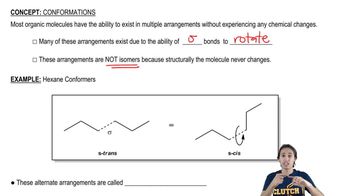
Understanding what a conformer is.

Equilibrium and Stability

In organic chemistry, equilibrium refers to the state where the rates of the forward and reverse reactions are equal. The stability of each conformer influences which side of the equilibrium is favored. Generally, the conformer with less steric hindrance and lower energy is favored, which can be predicted by analyzing the substituents' positions in the chair conformations.
Recommended video:
Guided course
03:43
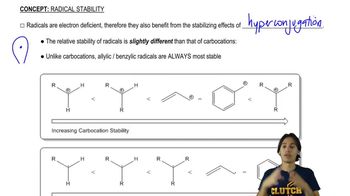
The radical stability trend.

Ring Flip Mechanism

The ring flip mechanism describes the process by which one chair conformation of cyclohexane converts to another. This involves the rotation of bonds and the inversion of axial and equatorial positions of substituents. Understanding this mechanism is essential for predicting the favored side of the equilibrium in chair-chair interconversions, as it directly impacts the steric interactions between substituents.
Recommended video:
Guided course
05:14
Ring Expansion