Ch. 5 - Chemical Reaction Analysis: Thermodynamics and Kinetics
Mullins - Organic Chemistry: A Learner Centered Approach 1st Edition
Mullins1st EditionOrganic Chemistry: A Learner Centered ApproachISBN: 9780137566471Not the one you use?Change textbook
Chapter 4, Problem 2c

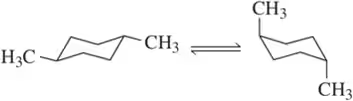
Predict which side of the equilibrium is favored for each of the chair–chair interconversions (ring flips) shown.
(c) Chair conformations of a cycloalkane showing interconversion with methyl groups on opposite sides.

Verified step by step guidance
1
Identify the substituents on the cyclohexane ring in both chair conformations. Determine whether each substituent is in an axial or equatorial position in each conformation.
Recall that substituents in the equatorial position are generally more stable than those in the axial position due to reduced 1,3-diaxial interactions (steric hindrance).
Compare the stability of the two chair conformations by analyzing the positions of the substituents. Count the number of substituents in the equatorial position for each conformation.
Determine which chair conformation is more stable based on the substituents' positions. The conformation with more substituents in the equatorial position is typically favored.
Conclude which side of the equilibrium is favored by identifying the more stable chair conformation. The equilibrium will favor the conformation with lower energy (more equatorial substituents).

Verified video answer for a similar problem:

This video solution was recommended by our tutors as helpful for the problem above.
Video duration:
4m
Was this helpful?

Key Concepts

Here are the essential concepts you must grasp in order to answer the question correctly.

Chair Conformation

The chair conformation is a three-dimensional structure of cyclohexane that minimizes steric strain and torsional strain. It is the most stable form of cyclohexane, allowing for optimal bond angles and positioning of substituents. Understanding chair conformations is crucial for predicting the stability of different isomers and their interconversions.
Recommended video:
Guided course
03:29
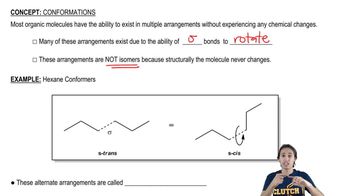
Understanding what a conformer is.

Equilibrium and Reaction Favorability

In organic chemistry, equilibrium refers to the state where the rates of the forward and reverse reactions are equal, resulting in constant concentrations of reactants and products. The side of the equilibrium that is favored is determined by factors such as stability, energy levels, and the nature of substituents. Analyzing these factors helps predict which chair conformation will be more prevalent.
Recommended video:
Guided course
04:00
Determining Acid/Base Equilibrium

Ring Flip Mechanism

The ring flip mechanism describes the process by which cyclohexane interconverts between two chair conformations. During this process, axial substituents become equatorial and vice versa, affecting steric interactions and overall stability. Recognizing how substituents influence the energy of each conformation is essential for predicting the favored side of the equilibrium in chair–chair interconversions.
Recommended video:
Guided course
05:14
Ring Expansion