
Ch. 27 - Carbohydrates, Nucleic Acids, and Lipids
Mullins - Organic Chemistry: A Learner Centered Approach 1st Edition
Mullins1st EditionOrganic Chemistry: A Learner Centered ApproachISBN: 9780137566471Not the one you use?Change textbook
Chapter 26, Problem 72

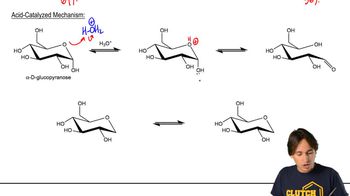
(a) Suggest an arrow-pushing mechanism for the mutarotation of α-d-glucose to β-d-glucose in the presence of acid. Acid isn’t necessary, but it does increase the rate of the process.
(b) What is the role of acid in your mechanism?

Verified step by step guidance
1
Step 1: Understand the concept of mutarotation. Mutarotation is the change in optical rotation due to the change in equilibrium between two anomers, α and β, of a sugar. In this case, α-d-glucose and β-d-glucose are interconverted.
Step 2: Recognize the structure of α-d-glucose and β-d-glucose. Both are cyclic forms of glucose, but differ in the orientation of the hydroxyl group at the anomeric carbon (C1). In α-d-glucose, the hydroxyl group is axial (down), while in β-d-glucose, it is equatorial (up).
Step 3: Initiate the mechanism with the protonation of the hydroxyl group at the anomeric carbon. The presence of acid facilitates this step by providing protons (H⁺), which increases the electrophilicity of the anomeric carbon, making it more susceptible to nucleophilic attack.
Step 4: Describe the ring-opening step. The protonated hydroxyl group at the anomeric carbon can lead to the cleavage of the C-O bond, forming an open-chain aldehyde form of glucose. This step involves the movement of electrons, which can be shown using curved arrows in the mechanism.
Step 5: Explain the ring-closing step to form β-d-glucose. The open-chain form can undergo nucleophilic attack by the hydroxyl group at C5, leading to the formation of a hemiacetal and closing the ring to form β-d-glucose. The acid catalyzes this step by stabilizing the transition state and intermediates.

Verified video answer for a similar problem:

This video solution was recommended by our tutors as helpful for the problem above.
Video duration:
5m
Was this helpful?

Key Concepts

Here are the essential concepts you must grasp in order to answer the question correctly.

Mutarotation

Mutarotation is the change in optical rotation that occurs when an alpha (α) anomer of a sugar converts to a beta (β) anomer, or vice versa, in solution. This process involves the opening of the cyclic sugar structure to form an open-chain form, followed by reclosure to form a different anomer. Understanding mutarotation is crucial for explaining the interconversion between α-d-glucose and β-d-glucose.
Recommended video:

Arrow-Pushing Mechanism

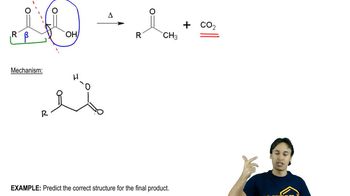
Arrow-pushing is a technique used in organic chemistry to illustrate the movement of electrons during chemical reactions. It involves using curved arrows to show the flow of electron pairs, helping to visualize how bonds are broken and formed. In the context of mutarotation, arrow-pushing helps depict the steps involved in the conversion of α-d-glucose to β-d-glucose, especially in the presence of an acid catalyst.
Recommended video:
Guided course
04:32
General Mechanism

Role of Acid Catalysis

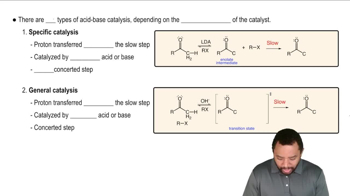
Acid catalysis involves the use of an acid to increase the rate of a chemical reaction. In the mutarotation of glucose, the acid donates a proton to the oxygen in the hemiacetal linkage, facilitating the opening of the ring structure. This protonation step lowers the energy barrier for the reaction, making the interconversion between anomers faster and more efficient.
Recommended video:
2:50
Acid-Base Catalysis Concept 3