
Textbook Question
Starting with a Fischer projection of d-glucose (and other sugars), switch only the stereocenter that gave it the designation of d. What new sugar have you made? [Hint: The answer is not l-glucose.]

 Verified step by step guidance
 2:02
2:02
 08:17
08:17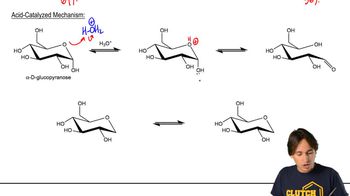 03:06
03:06Starting with a Fischer projection of d-glucose (and other sugars), switch only the stereocenter that gave it the designation of d. What new sugar have you made? [Hint: The answer is not l-glucose.]
Suggest a mechanism by which TXB2 might be formed from TXA2 in an acid-catalyzed hydrolysis reaction. [The structure has been simplified.]
(a) Suggest an arrow-pushing mechanism for the mutarotation of α-d-glucose to β-d-glucose in the presence of acid. Acid isn’t necessary, but it does increase the rate of the process.
(b) What is the role of acid in your mechanism?
The α- and β-anomers of glucose are shown here.
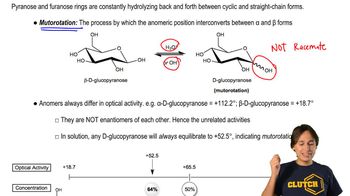
In solution, these two epimers can interconvert through a process called mutarotation. What is the ratio of anomers (α:β) when the specific rotation is +52.6°
The α- and β-anomers of glucose are shown here. In solution, these two epimers can interconvert through a process called mutarotation.
Given that α-D-glucose has a specific rotation of + 112.2° , why is the specific rotation of β-D-glucose not -112.2°? What molecule would have a specific rotation of -112.2°?
Is the compound d or l?