Ch. 2 - General Chemistry Translated: Finding the Electrons
Mullins - Organic Chemistry: A Learner Centered Approach 1st Edition
Mullins1st EditionOrganic Chemistry: A Learner Centered ApproachISBN: 9780137566471Not the one you use?Change textbook
Chapter 1, Problem 85c

Looking ahead in Chapter 3, we describe how the formal charge on an atom can be used to predict the number of lone pairs. Given the charge, or lack of charge, on each atom, fill in the electron pairs.
(c) Chemical structure of methanol, showing the molecular formula H3C-OH.

Verified step by step guidance
1
Step 1: Identify the atoms in the molecule and their valence electrons. The molecule contains carbon (C), hydrogen (H), and oxygen (O). Carbon has 4 valence electrons, hydrogen has 1 valence electron, and oxygen has 6 valence electrons.
Step 2: Determine the bonding structure. The central carbon atom is bonded to two methyl groups (CH3), one hydroxyl group (OH), and has no formal charge. Each hydrogen atom in the methyl groups forms a single bond with carbon, and the oxygen in the hydroxyl group forms a single bond with carbon.
Step 3: Assign lone pairs to the oxygen atom. Oxygen typically has two lone pairs when it is neutral. Since the oxygen atom in the hydroxyl group is bonded to hydrogen and carbon, it will have two lone pairs to complete its octet.
Step 4: Verify the formal charges. The carbon atom is neutral because it has four bonds (no lone pairs). The oxygen atom is neutral because it has two bonds and two lone pairs. The hydrogen atoms are neutral because they each form one bond.
Step 5: Draw the complete Lewis structure, ensuring all atoms have the correct number of bonds and lone pairs. The central carbon atom is bonded to two CH3 groups and one OH group. The oxygen atom in the OH group has two lone pairs, and all hydrogen atoms are bonded appropriately.

Verified video answer for a similar problem:

This video solution was recommended by our tutors as helpful for the problem above.
Video duration:
5m
Was this helpful?

Key Concepts

Here are the essential concepts you must grasp in order to answer the question correctly.

Formal Charge

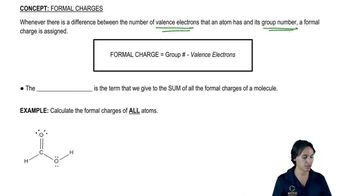
Formal charge is a theoretical charge assigned to an atom in a molecule, calculated based on the number of valence electrons, the number of bonds, and the number of lone pairs. It helps in determining the most stable structure of a molecule by indicating how electrons are distributed among atoms. A formal charge of zero is often preferred for stability, and understanding this concept is crucial for predicting molecular geometry and reactivity.
Recommended video:
Guided course
01:34
Calculating formal and net charge.

Lone Pairs

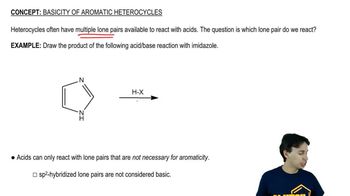
Lone pairs are pairs of valence electrons that are not involved in bonding and are localized on a single atom. They play a significant role in determining the shape and polarity of molecules, as they can influence the spatial arrangement of atoms. Recognizing the presence and number of lone pairs is essential for predicting molecular geometry using VSEPR theory, which is vital for understanding the behavior of the molecule in chemical reactions.
Recommended video:
Guided course
02:04
Heterocycles - Which lone pairs react?

Hydroxyl Group

The hydroxyl group (-OH) is a functional group consisting of an oxygen atom bonded to a hydrogen atom. It is characteristic of alcohols and is polar due to the electronegativity of oxygen, which affects the molecule's solubility and reactivity. Understanding the properties of the hydroxyl group is important for predicting how the molecule will interact with other substances, including its acidity and ability to form hydrogen bonds.
Recommended video:
Guided course
04:42
Sequence Groups