Ch. 2 - General Chemistry Translated: Finding the Electrons
Mullins - Organic Chemistry: A Learner Centered Approach 1st Edition
Mullins1st EditionOrganic Chemistry: A Learner Centered ApproachISBN: 9780137566471Not the one you use?Change textbook
Chapter 1, Problem 84

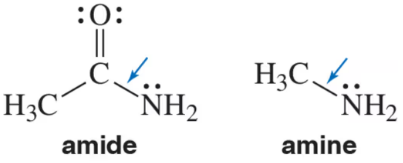
The C―N bond in the following amide is much stronger than the C―N bond in the amine. Explain.

Verified step by step guidance
1
Examine the structures of the amide and the amine. In the amide, the nitrogen is bonded to a carbonyl group (C=O), whereas in the amine, the nitrogen is bonded to a simple alkyl group (CH3). This difference in bonding is key to understanding the strength of the C-N bond.
Consider resonance effects in the amide. The lone pair of electrons on the nitrogen in the amide can delocalize into the carbonyl group, forming a resonance structure. This delocalization increases the electron density between the carbon and nitrogen, strengthening the C-N bond.
Analyze the absence of resonance in the amine. In the amine, the nitrogen's lone pair cannot delocalize into a carbonyl group because there is no such group present. This results in a weaker C-N bond compared to the amide.
Evaluate the hybridization of the carbon atom in the amide. The carbonyl carbon in the amide is sp2 hybridized, which results in a shorter and stronger bond with the nitrogen due to increased orbital overlap. In the amine, the carbon is sp3 hybridized, leading to a longer and weaker bond.
Conclude that the combination of resonance stabilization and hybridization effects in the amide contributes to the stronger C-N bond compared to the amine.

Verified video answer for a similar problem:

This video solution was recommended by our tutors as helpful for the problem above.
Video duration:
4m
Was this helpful?

Key Concepts

Here are the essential concepts you must grasp in order to answer the question correctly.

Resonance Stabilization

In amides, the carbonyl group (C=O) can delocalize electron density through resonance with the nitrogen atom. This resonance stabilization increases the overall strength of the C-N bond in amides compared to amines, where such resonance is absent. The ability of the carbonyl to stabilize the lone pair on nitrogen enhances the bond strength.
Recommended video:
Guided course
03:43
The radical stability trend.

Hybridization and Bonding

The C-N bond in amides involves sp2 hybridization of the carbon atom, which leads to a stronger sigma bond due to the greater s-character compared to the sp3 hybridization in amines. The increased s-character in sp2 hybridized orbitals results in a shorter and stronger bond, contributing to the overall stability of the amide structure.
Recommended video:
Guided course
10:43
Using bond sites to predict hybridization

Electronegativity and Inductive Effects

The presence of the electronegative oxygen atom in the carbonyl group of amides exerts an inductive effect that pulls electron density away from the C-N bond. This effect enhances the bond strength by increasing the partial positive charge on the nitrogen, making it more effective in stabilizing the bond. In contrast, amines lack this strong electronegative influence, resulting in weaker C-N bonds.
Recommended video:
Guided course
1:47
Electronegativity