Ch. 16 - Reactions of Aldehydes and Ketones • More Reactions of Carboxylic Acid Derivatives
Bruice - Organic Chemistry 8th Edition
Bruice8th EditionOrganic ChemistryISBN: 9780135213711Not the one you use?Change textbook
Chapter 17, Problem 24

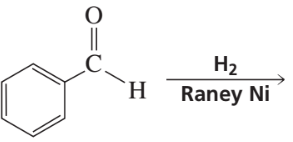
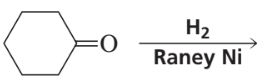
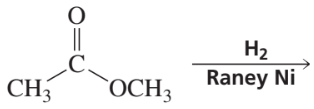
What are the products of the following reactions?
a.
b.
c.
d. Chemical structure showing a carbonyl group with methyl and methoxy groups, indicating a reaction with hydrogen and Raney nickel.

Verified step by step guidance
1
Step 1: Understand the role of H2 and Raney Ni in these reactions. Raney nickel (Ni) is a catalyst commonly used for hydrogenation reactions. It facilitates the addition of hydrogen (H2) to unsaturated bonds such as double bonds, triple bonds, nitriles, and carbonyl groups.
Step 2: For reaction (a), identify the functional group in the starting material. If the starting material contains a double or triple bond, Raney Ni will catalyze the hydrogenation, converting it to a single bond. For example, an alkene (C=C) will be reduced to an alkane (C-C).
Step 3: For reaction (b), CH3CH2CH2C≡N, recognize that the nitrile group (C≡N) undergoes hydrogenation in the presence of H2 and Raney Ni. This reaction converts the nitrile group into a primary amine (-CH2NH2).
Step 4: For reaction (c), analyze the starting material. If it contains a functional group such as a carbonyl (C=O) or an unsaturated bond, Raney Ni will catalyze its reduction. For example, a ketone (C=O) will be reduced to an alcohol (-CH2OH).
Step 5: For reaction (d), CH3(C=O)OCH3, identify the ester functional group. Under hydrogenation conditions with Raney Ni, the ester can be reduced to an alcohol. Specifically, the ester bond (C=O and C-O) will break, forming two alcohols: one from the carbonyl group and one from the alkoxy group.

Verified video answer for a similar problem:

This video solution was recommended by our tutors as helpful for the problem above.
Video duration:
2m
Was this helpful?

Key Concepts

Here are the essential concepts you must grasp in order to answer the question correctly.

Hydrogenation

Hydrogenation is a chemical reaction that involves the addition of hydrogen (H2) to unsaturated organic compounds, typically alkenes or alkynes, to convert them into saturated hydrocarbons. This process is often facilitated by catalysts such as Raney nickel, which enhances the reaction rate and selectivity. Understanding hydrogenation is crucial for predicting the products of reactions involving unsaturated substrates.
Recommended video:
Guided course
00:48
The definition of hydrogenation.

Raney Nickel Catalyst

Raney nickel is a finely divided nickel-aluminum alloy that serves as a highly effective catalyst for hydrogenation reactions. It is particularly useful in reducing carbon-carbon double and triple bonds, as well as in the hydrogenation of functional groups like nitriles and carbonyls. Familiarity with the properties and applications of Raney nickel is essential for understanding its role in the reactions presented.
Recommended video:
Guided course
03:17
Raney Nickel Reduction

Functional Group Transformations

Functional group transformations refer to the chemical reactions that convert one functional group into another, altering the reactivity and properties of organic molecules. In the context of the given reactions, recognizing how hydrogenation affects various functional groups, such as nitriles and esters, is vital for predicting the final products. This concept is foundational in organic synthesis and reaction mechanisms.
Recommended video:
Guided course
02:36
Identifying Functional Groups