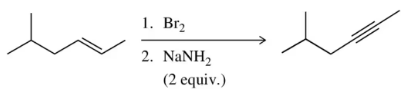
The introduction of elimination reactions provides a second way to synthesize alkynes in a two-step process starting with an alkene. Suggest a mechanism for both steps of this process.
Verified step by step guidance
1
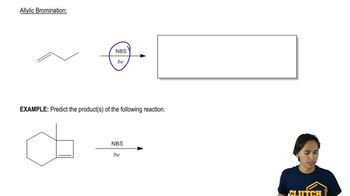
Step 1: Analyze the starting material, which is an alkene. The first step involves the addition of bromine (Br₂) to the alkene. This reaction proceeds via an electrophilic addition mechanism, where the π-electrons of the alkene attack the bromine molecule, forming a bromonium ion intermediate.
Step 2: The bromonium ion is then attacked by a bromide ion (Br⁻), leading to the formation of a vicinal dibromide (a molecule with two bromine atoms attached to adjacent carbons). This completes the first step of the process.
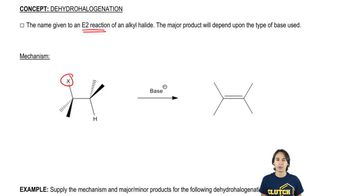
Step 3: In the second step, the vicinal dibromide undergoes two consecutive elimination reactions in the presence of a strong base, sodium amide (NaNH₂). The base abstracts a proton from one of the carbons adjacent to a bromine atom, leading to the formation of a double bond and the elimination of a bromide ion.
Step 4: The second equivalent of NaNH₂ then abstracts another proton from the carbon adjacent to the remaining bromine atom, resulting in the formation of a triple bond (alkyne) and the elimination of the second bromide ion.
Step 5: The final product is an alkyne, specifically a terminal alkyne in this case, as the elimination reactions lead to the formation of a triple bond at the end of the carbon chain.
Verified video answer for a similar problem:
This video solution was recommended by our tutors as helpful for the problem above
Play a video:
0 Comments
Key Concepts
Here are the essential concepts you must grasp in order to answer the question correctly.
Elimination Reactions
Elimination reactions involve the removal of atoms or groups from a molecule, resulting in the formation of a double or triple bond. In the context of synthesizing alkynes, elimination typically occurs in two steps: first, a halogen is added to an alkene, followed by a dehydrohalogenation step where a base removes a hydrogen halide, leading to the formation of an alkyne.
The bromination of alkenes involves the addition of bromine (Br2) across the double bond, resulting in a vicinal dibromide. This reaction proceeds through a cyclic bromonium ion intermediate, which is then attacked by a bromide ion, leading to the formation of the dibrominated product. Understanding this mechanism is crucial for predicting the subsequent elimination step.
In the second step of the synthesis, sodium amide (NaNH2) acts as a strong base to remove a hydrogen atom and a bromine atom from the vicinal dibromide, resulting in the formation of a triple bond. This process, known as dehydrohalogenation, is essential for converting the dibromide intermediate into the desired alkyne product, showcasing the importance of strong bases in elimination reactions.

 Verified step by step guidance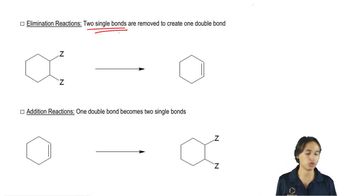
 00:40
00:40