Calculate for the following acid–base reactions. Which is the best base to use to deprotonate acetylene and make the acetylide anion? (b) H2N- + H―C ≡ C―H ⇌ -C ≡ C―H + H3N
Verified step by step guidance
1
Step 1: Understand the problem. The goal is to determine which base is best suited to deprotonate acetylene (H―C≡C―H) and form the acetylide anion (⁻C≡C―H). This involves comparing the acid–base equilibrium and analyzing the relative strengths of the acids and bases involved.
Step 2: Write the acid–base reaction. The given reaction is: . Here, H₂N⁻ is the base, H―C≡C―H is the acid, ⁻C≡C―H is the conjugate base, and H₃N is the conjugate acid.
Step 3: Compare the pKa values of the acids. The pKa of acetylene (H―C≡C―H) is approximately 25, while the pKa of ammonia (H₃N) is approximately 38. Since a stronger acid has a lower pKa, acetylene is the stronger acid compared to ammonia.
Step 4: Analyze the equilibrium direction. The equilibrium of the reaction will favor the formation of the weaker acid and weaker base. Since ammonia (H₃N) is a weaker acid than acetylene, the equilibrium will favor the products (⁻C≡C―H and H₃N). This indicates that H₂N⁻ is a suitable base for deprotonating acetylene.
Step 5: Conclude the reasoning. Based on the pKa comparison and equilibrium analysis, H₂N⁻ is a strong enough base to deprotonate acetylene and form the acetylide anion (⁻C≡C―H). The reaction proceeds because the conjugate acid (H₃N) is weaker than the original acid (H―C≡C―H).
Verified video answer for a similar problem:
This video solution was recommended by our tutors as helpful for the problem above
Play a video:
0 Comments
Key Concepts
Here are the essential concepts you must grasp in order to answer the question correctly.
Acidity and Basicity
Acidity refers to the tendency of a compound to donate protons (H⁺), while basicity is the ability to accept protons. In organic chemistry, the strength of an acid is often measured by its pKa value; lower pKa values indicate stronger acids. Understanding the relative strengths of acids and bases is crucial for predicting the outcome of acid-base reactions.
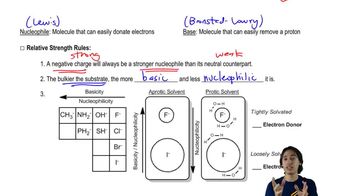
Understanding the difference between basicity and nucleophilicity.
Acetylide Anion
The acetylide anion (⁻C≡C―H) is formed when acetylene (H―C≡C―H) is deprotonated. This anion is a strong nucleophile and can participate in various reactions, including nucleophilic substitutions. Recognizing the structure and reactivity of the acetylide anion is essential for understanding its role in organic synthesis.
To deprotonate a weak acid like acetylene, a strong base is required. Common strong bases include alkyl lithium reagents and amides like H₂N⁻ (amide ion). The choice of base affects the efficiency of the deprotonation process, making it important to select a base that is stronger than the conjugate acid of the target compound.