Ch. 26 - Amino Acids, Proteins, and Peptide Synthesis
Mullins - Organic Chemistry: A Learner Centered Approach 1st Edition
Mullins1st EditionOrganic Chemistry: A Learner Centered ApproachISBN: 9780137566471Not the one you use?Change textbook
Chapter 25, Problem 38

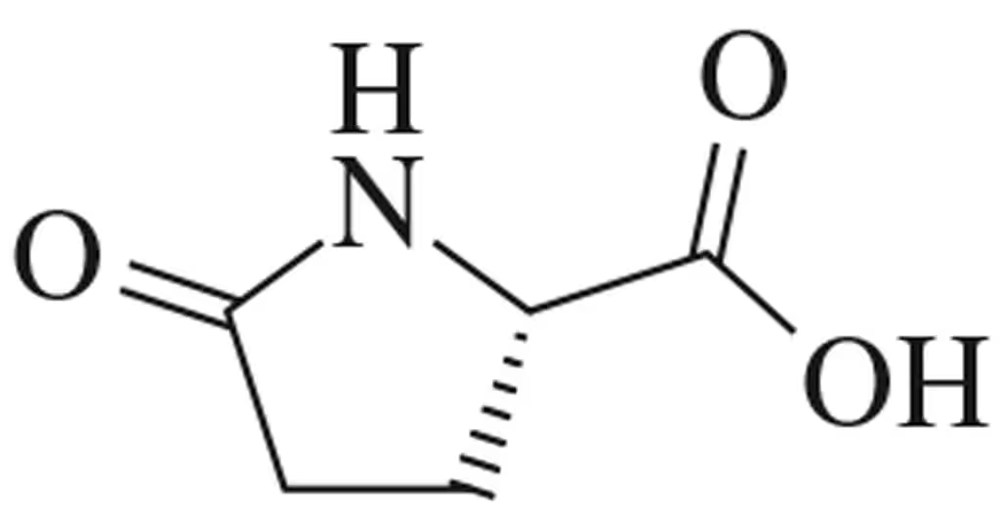
The first amino acid in the pentapeptide of Figure 26.50, Pyr, is not one of the 20 amino acids in Table 26.1. Based on the following structure of Pyr, from which natural amino acid is it likely derived?
Chemical structure of Pyr, an amino acid not found in the standard 20, showing its unique molecular composition.

Verified step by step guidance
1
Examine the structure of Pyr provided in the image. It consists of a five-membered ring with a nitrogen atom and a carboxylic acid group attached to the ring.
Identify the functional groups present in the structure. The five-membered ring is a lactam, which is a cyclic amide. The presence of the carboxylic acid group suggests it is an amino acid derivative.
Compare the structure of Pyr to the structures of the 20 standard amino acids. Look for similarities in the ring structure and functional groups.
Recognize that the five-membered ring with a nitrogen atom is characteristic of the amino acid proline, which has a pyrrolidine ring.
Conclude that Pyr is likely derived from proline, as the structure resembles a modified proline with an additional carbonyl group forming a lactam.

Verified video answer for a similar problem:

This video solution was recommended by our tutors as helpful for the problem above.
Video duration:
2m
Was this helpful?

Key Concepts

Here are the essential concepts you must grasp in order to answer the question correctly.

Amino Acids and Their Derivatives

Amino acids are organic compounds that serve as the building blocks of proteins. There are 20 standard amino acids, each with a unique side chain that determines its properties. Some amino acids can undergo modifications or derivations, leading to the formation of non-standard amino acids, such as Pyr, which may be derived from natural amino acids through post-translational modifications or biosynthetic pathways.
Recommended video:
Guided course
03:50
Intro to Carboxylic Acid Derivatives

Peptide Structure

Peptides are short chains of amino acids linked by peptide bonds. The sequence and composition of amino acids in a peptide determine its structure and function. Understanding the structure of a peptide, including any non-standard amino acids, is crucial for identifying its origin and potential biological roles, as well as for predicting its interactions with other biomolecules.
Recommended video:
3:07
Peptides Concept 1

Biosynthesis of Amino Acids

The biosynthesis of amino acids involves various metabolic pathways that convert simple precursors into amino acids. Some amino acids can be synthesized from others through transamination or other enzymatic reactions. Recognizing the pathways and precursors involved in amino acid synthesis is essential for deducing the likely natural amino acid from which a non-standard amino acid, like Pyr, is derived.
Recommended video:
Guided course
09:36
Standard Amino Acids