The first amino acid in the pentapeptide of Figure 26.50, Pyr, is not one of the 20 amino acids in Table 26.1. Based on the following structure of Pyr, from which natural amino acid is it likely derived?
Ch. 26 - Amino Acids, Proteins, and Peptide Synthesis

Mullins1st EditionOrganic Chemistry: A Learner Centered ApproachISBN: 9780137566471Not the one you use?Change textbook
Chapter 25, Problem 32
Why are conjugated molecules like the product of the ninhydrin reaction brightly colored?
Verified step by step guidance1
Conjugated molecules have alternating single and double bonds, which allow for the delocalization of π-electrons across the molecule. This delocalization lowers the energy gap between the ground state and the excited state of the electrons.
The energy required to excite an electron from the ground state to an excited state in conjugated systems is often in the visible region of the electromagnetic spectrum. This means that when these electrons absorb light, they do so in the visible range, which is why we perceive them as colored.
In the case of the ninhydrin reaction, the product formed is a conjugated system. The reaction typically involves the formation of a colored compound known as Ruhemann's purple, which is a result of the extended conjugation in the product.
The color intensity and specific hue depend on the extent of conjugation and the specific structure of the conjugated system. More extensive conjugation generally results in absorption of longer wavelengths of light, which can shift the color observed.
Understanding the relationship between conjugation and color can be useful in various applications, such as in the design of dyes and pigments, where specific colors are desired based on the molecular structure.

Verified video answer for a similar problem:
This video solution was recommended by our tutors as helpful for the problem above.
Was this helpful?
Key Concepts
Here are the essential concepts you must grasp in order to answer the question correctly.
Conjugation in Organic Molecules
Conjugation occurs when p-orbitals overlap across adjacent single and multiple bonds, allowing for delocalization of electrons. This delocalization lowers the energy gap between molecular orbitals, which can affect the absorption of light and result in visible color. Conjugated systems are often more stable and can absorb specific wavelengths of light, leading to the appearance of color.
Recommended video:
Guided course
Identifying organic molecules
Ninhydrin Reaction
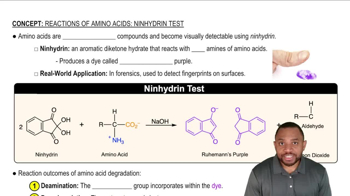
The ninhydrin reaction is a chemical test used to detect amino acids and proteins. When ninhydrin reacts with amino acids, it forms a colored product, typically Ruhemann's purple. This reaction involves the formation of a conjugated system, which is responsible for the bright color observed. The color intensity can be used to quantify the presence of amino acids.
Recommended video:
Reactions of Amino Acids: Nihydrin Test Concept 1
Light Absorption and Color
The color of a compound is determined by the wavelengths of light it absorbs and reflects. Conjugated systems absorb light in the visible spectrum due to their lower energy gaps, which results in the emission of complementary colors. The specific color observed depends on the extent of conjugation and the specific wavelengths absorbed by the molecule.
Recommended video:
Guided course
Reaction with diazomethane and light or heat.
Related Practice
Textbook Question
2
views
Textbook Question
Show how you would synthesize the following amino acids using the Strecker amino acid synthesis.
a. Ala
1
views
Textbook Question
Draw the following amino acids in all possible protonation states as you move from high pH to low pH.
b. His
1
views
Textbook Question
Although there is free rotation around most σ bonds, rotation is restricted around the C--N bond of an amide. Explain why this is true.
1
views
Textbook Question
Provide a mechanism for the protection of the amine as the benzylcarbamate shown in Figure 26.33(a). <IMAGE>
Textbook Question
Provide a synthesis of the following amino acids using a combination of the HVZ and amination reactions.
b. Leu
6
views