Ch. 21 - Carboxylic Acid Derivatives
Wade - Organic Chemistry 9th Edition
Wade9th EditionOrganic ChemistryISBN: 9780135213728Not the one you use?Change textbook
Chapter 21, Problem 41d

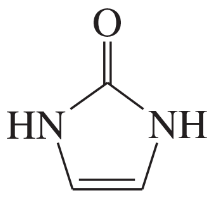
For each heterocyclic compound,
(i) explain what type of acid derivative is present.
(ii) show what compounds would result from complete hydrolysis.
(iii) are any of the rings aromatic? Explain.
(d)

Verified step by step guidance
1
Step 1: Identify the type of acid derivative present in the heterocyclic compound. The structure contains a lactam functional group, which is a cyclic amide. The carbonyl group (C=O) is directly bonded to a nitrogen atom within the ring.
Step 2: Determine the products of complete hydrolysis. Hydrolysis of a lactam involves breaking the amide bond. This reaction typically yields a carboxylic acid and an amine. In this case, the hydrolysis of the lactam ring would produce a carboxylic acid group and a diamine (specifically ethylenediamine).
Step 3: Assess the aromaticity of the ring. Aromatic compounds must satisfy Huckel's rule, which states that a planar, cyclic molecule must have (4n + 2) π-electrons to be aromatic. The ring in this structure is not aromatic because it does not have a conjugated π-electron system that satisfies Huckel's rule.
Step 4: Explain the reasoning for aromaticity. The ring contains alternating single and double bonds, but the nitrogen atoms disrupt the conjugation due to their lone pairs. Additionally, the ring does not meet the (4n + 2) π-electron requirement for aromaticity.
Step 5: Summarize the findings. The compound contains a lactam functional group, hydrolysis yields a carboxylic acid and ethylenediamine, and the ring is not aromatic due to the lack of a conjugated π-electron system and failure to satisfy Huckel's rule.

Verified video answer for a similar problem:

This video solution was recommended by our tutors as helpful for the problem above.
Video duration:
4m
Was this helpful?

Key Concepts

Here are the essential concepts you must grasp in order to answer the question correctly.

Heterocyclic Compounds

Heterocyclic compounds are cyclic structures that contain at least one atom in the ring that is not carbon, typically nitrogen, oxygen, or sulfur. These compounds are significant in organic chemistry due to their diverse chemical properties and biological activities. Understanding the structure and reactivity of heterocycles is essential for predicting their behavior in chemical reactions, including hydrolysis.
Recommended video:
2:06
Nomenclature of Heterocycles Concept 1

Acid Derivatives

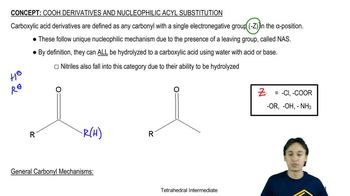
Acid derivatives are compounds that are derived from carboxylic acids by replacing the hydroxyl group (-OH) with another functional group. Common examples include amides, esters, and anhydrides. In the context of the given question, identifying the type of acid derivative present in the heterocyclic compound is crucial for understanding its reactivity and the products formed during hydrolysis.
Recommended video:
Guided course
03:50
Intro to Carboxylic Acid Derivatives

Aromaticity

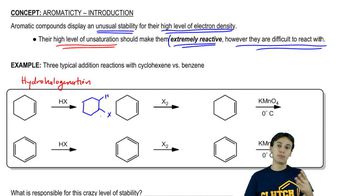
Aromaticity refers to the property of cyclic compounds that exhibit enhanced stability due to the delocalization of π-electrons across the ring structure, following Huckel's rule (4n + 2 π-electrons). Determining whether a heterocyclic compound is aromatic involves analyzing its structure for conjugation, planarity, and cyclicity. This concept is important for predicting the chemical behavior and reactivity of the compound.
Recommended video:
Guided course
08:19
Intro to Aromaticity