Ch. 19 - Amines
Wade - Organic Chemistry 9th Edition
Wade9th EditionOrganic ChemistryISBN: 9780135213728Not the one you use?Change textbook
Chapter 19, Problem 42a

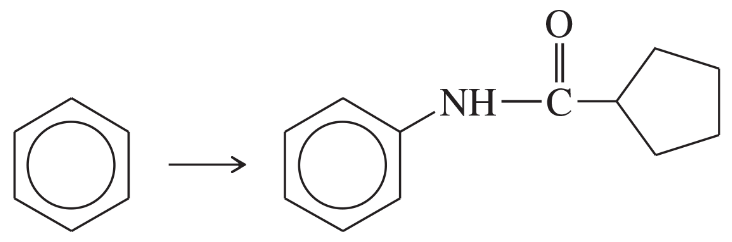
Using any necessary reagents, show how you would accomplish the following syntheses.
(a)

Verified step by step guidance
1
Step 1: Begin with benzene as the starting material. Perform a Friedel-Crafts acylation reaction using an acyl chloride (e.g., cyclohexanecarbonyl chloride) and a Lewis acid catalyst such as AlCl₃. This will introduce the cyclohexanecarbonyl group onto the benzene ring, forming phenyl cyclohexyl ketone.
Step 2: Reduce the ketone group to a methylene group using a reducing agent such as Clemmensen reduction (Zn/HCl) or Wolff-Kishner reduction (hydrazine and KOH). This step is optional if the ketone group is already desired.
Step 3: Introduce an amine group onto the benzene ring. This can be achieved by nitration of benzene (using HNO₃ and H₂SO₄) to form nitrobenzene, followed by reduction of the nitro group to an amine group using a reducing agent like Sn/HCl or catalytic hydrogenation.
Step 4: Perform an acylation reaction on the amine group using cyclohexanecarbonyl chloride. This will form the desired amide bond between the amine group and the cyclohexanecarbonyl group.
Step 5: Verify the structure of the final product, N-cyclohexylbenzamide, ensuring that the amide bond is correctly formed and the cyclohexyl group is attached to the carbonyl carbon.

Verified video answer for a similar problem:

This video solution was recommended by our tutors as helpful for the problem above.
Video duration:
5m
Was this helpful?

Key Concepts

Here are the essential concepts you must grasp in order to answer the question correctly.

Acylation

Acylation is a chemical reaction that introduces an acyl group (RCO-) into a molecule. In organic synthesis, this process often involves the reaction of an amine, such as aniline, with an acyl chloride or an acid anhydride. The result is the formation of an amide, which is characterized by the presence of a carbonyl group adjacent to a nitrogen atom. This reaction is crucial for modifying the properties of organic compounds.
Recommended video:
Guided course
05:20
Friedel-Crafts Acylation

Reagents in Organic Synthesis

Reagents are substances used to cause a chemical reaction or to test for the presence of another substance. In the context of acylation, common reagents include acyl chlorides (like acetyl chloride) and acid anhydrides. The choice of reagent can influence the reaction's efficiency, selectivity, and the nature of the final product. Understanding the role of these reagents is essential for successful organic synthesis.
Recommended video:
1:16
Synthesis of Amino Acids: Strecker Synthesis Example 1

Mechanism of Nucleophilic Acyl Substitution

Nucleophilic acyl substitution is a fundamental mechanism in organic chemistry where a nucleophile attacks an electrophilic carbonyl carbon, leading to the substitution of a leaving group. In the case of acylation of aniline, the nitrogen atom of the amine acts as the nucleophile, attacking the carbonyl carbon of the acyl chloride. This mechanism is vital for understanding how acylation reactions proceed and the formation of amides from amines.
Recommended video:
Guided course
01:47
Nucleophiles and Electrophiles can react in Substitution Reactions.