Ch. 22 - Condensations and Alpha Substitutions of Carbonyl Compounds
Wade - Organic Chemistry 9th Edition
Wade9th EditionOrganic ChemistryISBN: 9780135213728Not the one you use?Change textbook
Chapter 22, Problem 15

Propose a mechanism for the acid-catalyzed bromination of pentan-3-one.

Verified step by step guidance
1
Step 1: Begin by identifying the functional group in pentan-3-one. It is a ketone, which contains a carbonyl group (C=O). The carbonyl group is reactive due to the polarization of the C=O bond, making the carbon atom electrophilic.
Step 2: In the presence of an acid catalyst, the carbonyl oxygen atom is protonated by the acid (H⁺). This increases the electrophilicity of the carbonyl carbon, making it more susceptible to nucleophilic attack. Represent this step as: C5(O3)+HC5(OH3)
Step 3: The protonated ketone undergoes enolization. This involves the migration of a proton from an adjacent alpha-carbon to the oxygen atom, forming an enol intermediate. The enol form is characterized by a hydroxyl group (-OH) attached to a double-bonded carbon. Represent this as: C5(OH3)C5(OH2=C3)
Step 4: Bromine (Br₂) reacts with the enol intermediate. The double bond in the enol acts as a nucleophile and attacks the bromine molecule, leading to the formation of a bromonium ion intermediate. This step is followed by the loss of a proton to regenerate the ketone structure with a bromine atom attached to the alpha-carbon. Represent this as: C5(OH2=C3)+Br2C5(Br3)
Step 5: Finally, the acid catalyst is regenerated, completing the catalytic cycle. The product of the reaction is 3-bromo-pentan-3-one, where bromine has been added to the alpha-carbon adjacent to the carbonyl group. This step ensures the reaction is catalytic in acid.

Verified video answer for a similar problem:

This video solution was recommended by our tutors as helpful for the problem above.
Video duration:
7m
Was this helpful?

Key Concepts

Here are the essential concepts you must grasp in order to answer the question correctly.

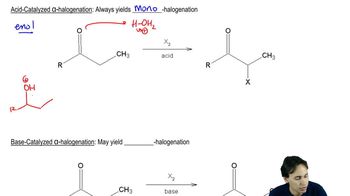
Acid-Catalyzed Reactions

Acid-catalyzed reactions involve the use of an acid to increase the rate of a chemical reaction. In organic chemistry, acids can protonate substrates, making them more electrophilic and susceptible to nucleophilic attack. Understanding how acids interact with organic molecules is crucial for proposing mechanisms, as they often dictate the pathway and intermediates formed during the reaction.
Recommended video:
Guided course
03:09
Acid Catalyzed

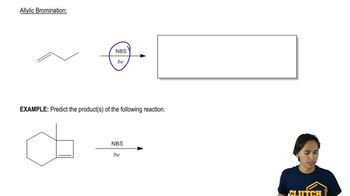
Bromination Mechanism

Bromination is the process of adding bromine to an organic compound, which can occur through various mechanisms, including electrophilic addition. In the case of ketones like pentan-3-one, the mechanism typically involves the formation of a bromonium ion or a similar intermediate, where bromine acts as an electrophile. Recognizing the steps involved in bromination helps in accurately proposing the reaction mechanism.
Recommended video:
Guided course
00:54
Mechanism of Allylic Bromination.

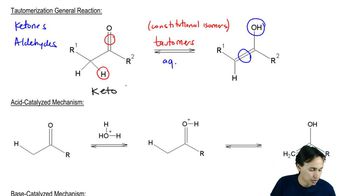
Keto-Enol Tautomerism

Keto-enol tautomerism is a chemical equilibrium between a keto form (a carbonyl compound) and its corresponding enol form (an alcohol with a double bond). In the context of pentan-3-one, the enol form can be more reactive towards electrophiles like bromine. Understanding this tautomerism is essential for predicting which form will participate in the bromination reaction and how the mechanism will unfold.
Recommended video:
Guided course
05:11
Tautomerization Mechanisms