Propose a mechanism for the acid-catalyzed bromination of pentan-3-one.
Ch. 22 - Condensations and Alpha Substitutions of Carbonyl Compounds
All textbooks
Wade 9th Edition
Ch. 22 - Condensations and Alpha Substitutions of Carbonyl Compounds
Problem 17
Wade 9th Edition
Ch. 22 - Condensations and Alpha Substitutions of Carbonyl Compounds
Problem 17Chapter 22, Problem 17
Show the products of the reactions of these carboxylic acids with PBr3/Br2 before and after hydrolysis.
(a) pentanoic acid
(b) phenylacetic acid
(c) succinic acid
(d) oxalic acid
Verified step by step guidance1
Step 1: Understand the reaction mechanism. The reaction involves the conversion of carboxylic acids into α-bromo acids using PBr3 and Br2, followed by hydrolysis. PBr3 activates the carboxylic acid, forming an acyl bromide intermediate, which reacts with Br2 to introduce a bromine atom at the α-carbon.
Step 2: Analyze the structure of each carboxylic acid. For (a) pentanoic acid, the α-carbon is adjacent to the carboxylic group. For (b) phenylacetic acid, the α-carbon is next to the benzyl group. For (c) succinic acid, there are two α-carbons due to the dicarboxylic nature. For (d) oxalic acid, there are no α-hydrogens, so bromination does not occur.
Step 3: Predict the intermediate products after the reaction with PBr3/Br2. For (a), the α-carbon of pentanoic acid will be brominated, forming α-bromopentanoic acid. For (b), phenylacetic acid will form α-bromophenylacetic acid. For (c), succinic acid will form α,α'-dibromosuccinic acid. For (d), oxalic acid will remain unchanged as it lacks α-hydrogens.
Step 4: Consider the hydrolysis step. Hydrolysis converts the acyl bromide intermediate back into the carboxylic acid, retaining the bromine substitution at the α-carbon. For (a), (b), and (c), the brominated carboxylic acids remain intact. For (d), no change occurs.
Step 5: Summarize the products. (a) α-bromopentanoic acid, (b) α-bromophenylacetic acid, (c) α,α'-dibromosuccinic acid, and (d) oxalic acid (unchanged).

Verified video answer for a similar problem:
This video solution was recommended by our tutors as helpful for the problem above.
Video duration:
2mWas this helpful?
Key Concepts
Here are the essential concepts you must grasp in order to answer the question correctly.
Carboxylic Acid Reactivity
Carboxylic acids are organic compounds characterized by the presence of a carboxyl group (-COOH). They are reactive due to the polar nature of the carbonyl and hydroxyl groups, allowing them to undergo various reactions, including halogenation and esterification. Understanding their reactivity is crucial for predicting the products formed when they react with reagents like PBr3 and Br2.
Recommended video:
Guided course
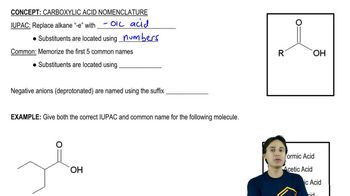
Carboxylic Acids Nomenclature
PBr3 and Halogenation
Phosphorus tribromide (PBr3) is a reagent commonly used to convert alcohols and carboxylic acids into their corresponding bromides. In the presence of Br2, PBr3 facilitates the halogenation of the carboxylic acid, leading to the formation of acyl bromides. This step is essential for understanding the initial products before hydrolysis occurs.
Recommended video:
Guided course
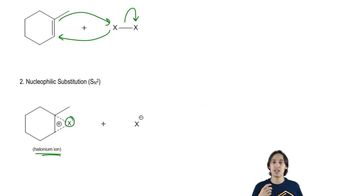
Halogenation Mechanism
Hydrolysis of Acyl Bromides
Hydrolysis is the reaction of a compound with water, leading to the breakdown of that compound. In the context of acyl bromides formed from carboxylic acids, hydrolysis results in the regeneration of the carboxylic acid and the release of bromide ions. This step is critical for determining the final products of the reaction sequence involving PBr3 and Br2.
Recommended video:
Peptide Sequencing: Partial Hydrolysis with Cyanogen Bromide Concept 1
Related Practice
Textbook Question
1
views
Textbook Question
Give the expected products for the aldol condensations of (a) propanal.
2
views
Textbook Question
Which compounds will give positive iodoform tests?
(a) 1-phenylethanol
(b) pentan-2-one
(c) pentan-2-ol
(d) pentan-3-one
(e) acetone
(f) isopropyl alcohol
1
views
Textbook Question
Propose a mechanism for the aldol condensation of cyclohexanone. Do you expect the equilibrium to favor the reactant or the product?
2
views
Textbook Question
Give the expected products for the aldol condensations of (b) phenylacetaldehyde.
3
views
Textbook Question
Acid-catalyzed halogenation is synthetically useful for converting ketones to α,β-unsaturated ketones, which are useful in Michael reactions (Section 22-18). Propose a method for converting cyclohexanone to cyclohex-2-en-1-one, an important synthetic starting material.
1
views