Ch. 20 - The Organic Chemistry of Carbohydrates
Bruice - Organic Chemistry 8th Edition
Bruice8th EditionOrganic ChemistryISBN: 9780135213711Not the one you use?Change textbook
Chapter 21, Problem 25

Draw the products formed when β-D-galactose reacts with ethanol and HCl. (Show all structures as chair conformers.)

Verified step by step guidance
1
Step 1: Recognize that β-D-galactose is a cyclic sugar in its pyranose form, which adopts a chair conformation. Identify the hydroxyl group on the anomeric carbon (C1) as the reactive site in this reaction.
Step 2: Understand the reaction mechanism. In the presence of ethanol and HCl, the hydroxyl group on the anomeric carbon undergoes acid-catalyzed substitution, forming an ethyl glycoside. This involves protonation of the hydroxyl group, followed by nucleophilic attack by ethanol.
Step 3: Draw the intermediate structure where the hydroxyl group on the anomeric carbon is protonated, making it a better leaving group. Then, show the nucleophilic attack of ethanol on the anomeric carbon, leading to the formation of the ethyl glycoside.
Step 4: Represent the final product as a chair conformer. Ensure that the ethyl group is attached to the anomeric carbon (C1) in place of the original hydroxyl group. The stereochemistry at C1 should remain consistent with the β configuration (the ethyl group is equatorial).
Step 5: Verify that all other substituents on the galactose ring remain unchanged in their original positions (hydroxyl groups at C2, C3, C4, and C6). Ensure the chair conformation is drawn accurately, with axial and equatorial positions clearly indicated.

Verified video answer for a similar problem:

This video solution was recommended by our tutors as helpful for the problem above.
Video duration:
3m
Was this helpful?

Key Concepts

Here are the essential concepts you must grasp in order to answer the question correctly.

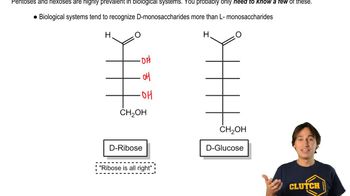
Monosaccharide Structure

b-D-galactose is a monosaccharide with a specific ring structure that can exist in different conformations, including the chair form. Understanding its structure is crucial for predicting how it will react with other molecules, such as ethanol. The hydroxyl groups on the sugar can participate in reactions, influencing the products formed.
Recommended video:
Guided course
06:06
Monosaccharides - Common Structures

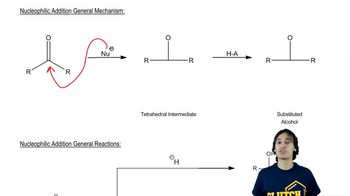
Ethanol as a Nucleophile

Ethanol acts as a nucleophile in this reaction, meaning it can donate a pair of electrons to form a bond with an electrophile. In the presence of HCl, the hydroxyl group of b-D-galactose can be protonated, making it a better leaving group. This facilitates the nucleophilic attack by ethanol, leading to the formation of an ether linkage.
Recommended video:
Guided course
08:27
Nucleophilic Addition

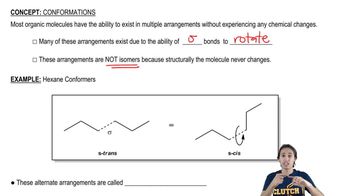
Chair Conformation

The chair conformation is a stable, three-dimensional arrangement of cyclohexane derivatives, including sugars like b-D-galactose. This conformation minimizes steric strain and allows for optimal positioning of substituents. When drawing the products, it is essential to represent the structures in their chair forms to accurately depict the spatial arrangement of atoms and the resulting stereochemistry.
Recommended video:
Guided course
03:29
Understanding what a conformer is.