Ch. 20 - The Organic Chemistry of Carbohydrates
Bruice - Organic Chemistry 8th Edition
Bruice8th EditionOrganic ChemistryISBN: 9780135213711Not the one you use?Change textbook
Chapter 21, Problem 28b

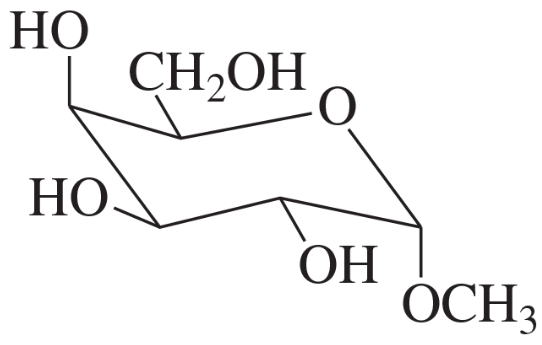
Name the following compounds and indicate whether or not each is a reducing sugar:
b.

Verified step by step guidance
1
Step 1: Identify the structure of the compound. The image shows a cyclic sugar with a six-membered ring, indicating it is a pyranose form. The presence of a methoxy group (-OCH₃) attached to the anomeric carbon suggests it is a glycoside.
Step 2: Determine the name of the sugar. The sugar is a derivative of glucose, as indicated by the hydroxyl groups (-OH) and the CH₂OH group at the 5th carbon. The methoxy group at the anomeric carbon replaces the typical hydroxyl group, forming a methyl glucoside.
Step 3: Specify the stereochemistry. The hydroxyl group on the anomeric carbon is replaced by the methoxy group, and the stereochemistry of the ring (α or β) depends on the orientation of the methoxy group. In this case, the methoxy group is pointing down, indicating the α configuration. The compound is α-methyl-D-glucopyranoside.
Step 4: Determine if the compound is a reducing sugar. Reducing sugars have a free anomeric carbon with a hydroxyl group (-OH) that can participate in redox reactions. Since the anomeric carbon in this compound is bonded to a methoxy group, it is not free and cannot act as a reducing sugar.
Step 5: Summarize the findings. The compound is named α-methyl-D-glucopyranoside, and it is not a reducing sugar because the anomeric carbon is not free.

Verified video answer for a similar problem:

This video solution was recommended by our tutors as helpful for the problem above.
Video duration:
6m
Was this helpful?

Key Concepts

Here are the essential concepts you must grasp in order to answer the question correctly.

Reducing Sugars

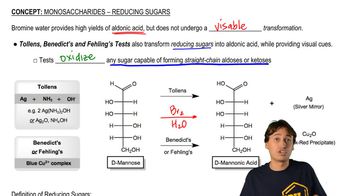
Reducing sugars are carbohydrates that can donate electrons to other molecules, typically due to the presence of a free aldehyde or ketone group. This property allows them to reduce certain chemical reagents, such as Benedict's or Fehling's solution, which is a key characteristic in identifying them. Common examples include glucose and fructose, which can participate in redox reactions.
Recommended video:
Guided course
08:42
Reducing Sugars

Structural Representation of Sugars

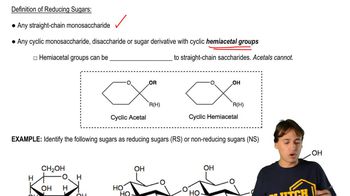
Understanding the structural representation of sugars is crucial for identifying their functional groups. Sugars can exist in linear or cyclic forms, and their structure determines their reactivity. Recognizing whether a sugar has a free aldehyde or ketone group in its structure is essential for determining if it is a reducing sugar.
Recommended video:
Guided course
02:21
Reducing Sugars

Nomenclature of Organic Compounds

Nomenclature refers to the systematic naming of organic compounds based on established rules, such as those set by IUPAC. For sugars, this includes identifying the number of carbon atoms, the type of functional groups, and the stereochemistry. Proper nomenclature is vital for clear communication in organic chemistry and helps in understanding the properties and reactivity of the compounds.
Recommended video:
Guided course
01:40
Defining meso compounds.